
The surface grinding finish is often the first quality characteristic your customer checks on a finished part. Whether the drawing calls for Ra 0.4 μm on a mold insert or Ra 1.6 μm on a machine base, achieving the correct finish consistently separates reliable suppliers from the rest. Therefore, understanding what controls surface grinding finish — and how to optimize it — is essential for every grinding operation.
What Is Surface Grinding Finish
Surface grinding finish describes the microscopic texture left on a workpiece after grinding. It is typically measured as Ra (roughness average) in micrometers or microinches. Lower Ra values indicate smoother surfaces, while higher values indicate rougher finishes.
Furthermore, different applications require different surface grinding finish levels:
- Mirror finish — Ra 0.05–0.1 μm — Required for optical components and precision gauges
- Fine finish — Ra 0.1–0.4 μm — Typical for mold inserts, precision tooling, and aerospace components
- Standard finish — Ra 0.4–1.6 μm — Common for general machine components and bearing surfaces
- Rough finish — Ra 1.6–6.3 μm — Acceptable for non-critical surfaces and structural parts
Consequently, knowing your required surface grinding finish before selecting equipment and parameters prevents costly mistakes. Explore machines capable of fine finish at https://surfacegrindermfg.com/
Factors That Determine Surface Grinding Finish
Multiple variables interact to produce the final surface grinding finish. Understanding each factor helps you control the result:
Grinding Wheel Grit Size
Wheel grit is the single most influential factor. Coarser grit (24-46) removes material faster but leaves a rougher finish. Finer grit (60-120) produces smoother surfaces at lower removal rates. Therefore, many operators use a two-step approach — coarse grit for roughing followed by fine grit for finishing. Learn about precision machines at https://surfacegrindermfg.com/cnc-surface-grinder/
Wheel Condition and Dressing
A freshly dressed wheel cuts cleanly and produces better surface grinding finish than a loaded or glazed wheel. Furthermore, the dressing pass itself affects finish — a slow, light dressing pass produces a smoother wheel surface, which in turn produces a smoother workpiece finish.
Depth of Cut
Lighter depths of cut reduce grinding force and heat input, resulting in improved surface grinding finish. For final passes, depths of 0.005–0.01mm typically produce the best results.
Feed Rate
Slower feed rates allow more cutting edges to engage the workpiece per unit length, improving finish. However, excessively slow feeds can cause rubbing instead of cutting, which degrades finish and generates heat.
Coolant Effectiveness
Proper coolant delivery prevents wheel loading and thermal damage, both of which worsen surface grinding finish. Clean, well-filtered coolant directed at the grinding zone is essential. The International Organization for Standardization addresses surface measurement standards at https://www.iso.org/
How to Improve Your Surface Grinding Finish
If your current grinding results do not meet the required Ra specification, try these proven adjustments:
- Switch to a finer grit wheel — Moving from 46 to 60 or 80 grit often delivers an immediate improvement
- Reduce the final pass depth — A light finishing pass of 0.005mm makes a significant difference
- Dress the wheel immediately before finishing — Fresh cutting edges produce cleaner surfaces
- Use spark-out passes — Allow the wheel to grind with no additional downfeed until all sparks stop
- Slow the crossfeed rate — Reducing crossfeed by 20-30% often improves Ra by 15-25%
- Verify coolant nozzle position — Ensure coolant hits the grinding zone directly, not from the side
- Check wheel balance — Vibration from an unbalanced wheel creates chatter marks that worsen finish
Implementing these steps systematically almost always improves the surface grinding finish. See hydraulic models with stable feed systems at https://surfacegrindermfg.com/hydraulic-surface-grinder/
Surface Grinding Finish by Industry Application
Different industries specify different Ra requirements, which drives process and equipment choices:
- Mold and die making — Ra 0.2–0.4 μm on cavity surfaces; requires fine-grit wheels and spark-out passes
- Aerospace — Ra 0.4–0.8 μm on structural components; surface integrity verification required beyond Ra measurement
- Automotive — Ra 0.4–1.6 μm on engine and transmission parts; balance between finish and productivity
- Medical devices — Ra 0.1–0.4 μm on implant surfaces; both Ra and Rz must meet specification
- General engineering — Ra 0.8–3.2 μm on most functional surfaces; standard grinding practice sufficient
Matching your surface grinding finish capability to your market requirements ensures you can meet customer expectations without over-investing in capability. Modern Machine Shop provides industry-specific grinding references at https://www.mmsonline.com/
Measuring Surface Grinding Finish
Accurate measurement is essential for verifying that you have achieved the required surface grinding finish. Common methods include:
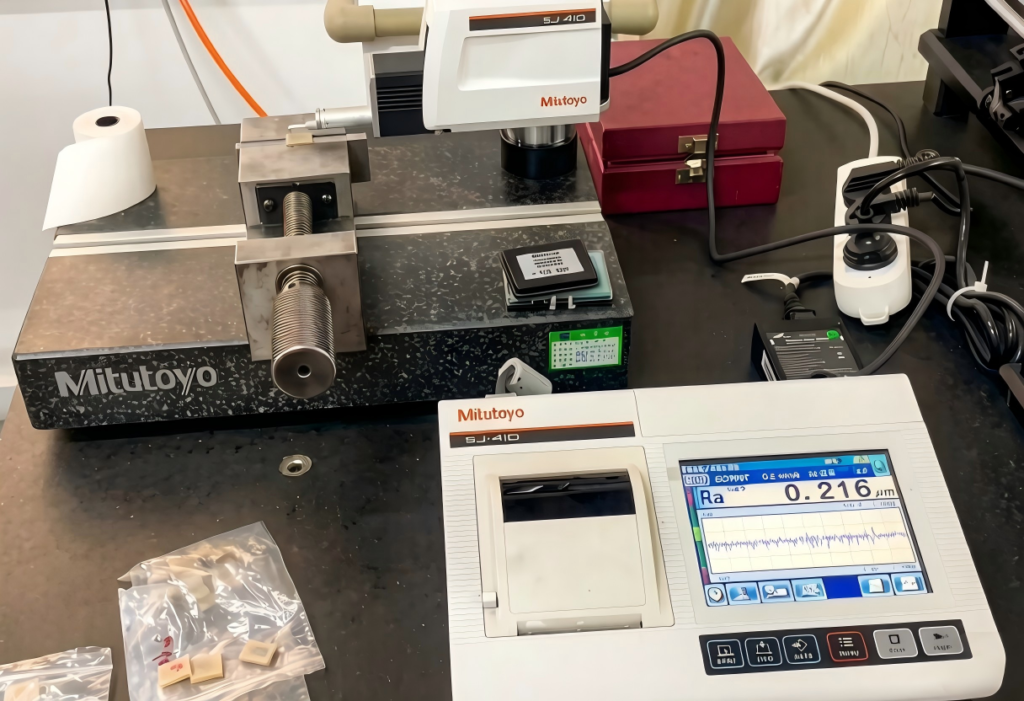
- Contact profilometers — The most common shop-floor instrument; traces a stylus across the surface and calculates Ra, Rz, and other parameters
- Non-contact optical profilers — Use laser or white-light interferometry for fine finishes below Ra 0.1 μm
- Comparator plates — Visual and tactile reference standards for quick estimation in the workshop
- In-process monitoring — Some CNC grinders integrate surface measurement for real-time quality control
Furthermore, measurement technique matters. Probe direction, cutoff length, and sampling length must match the applicable standard. Incorrect measurement settings produce misleading results. The European Commission provides measurement framework references at https://ec.europa.eu/
Common Surface Grinding Finish Problems and Solutions
Even experienced operators encounter finish problems. Here are the most frequent issues:
- Chatter marks — Regular patterns on the surface caused by vibration. Solution: Balance the wheel, check spindle bearings, reduce grinding force
- Feed lines — Visible parallel lines from crossfeed increments. Solution: Reduce crossfeed rate, use spark-out passes, ensure smooth crossfeed mechanism
- Wheel loading — Material bonds to the wheel surface, degrading finish. Solution: Use sharper wheel grade, improve coolant, dress more frequently
- Thermal damage — Discoloration or burn marks that affect surface integrity. Solution: Reduce depth of cut, improve coolant, use softer wheel grade
- Inconsistent finish across the workpiece — Varies from one area to another. Solution: Check wheel wear pattern, verify chuck flatness, ensure consistent coolant coverage
Each problem has a specific root cause. Therefore, systematic diagnosis — rather than trial-and-error — is the fastest path to a consistent surface grinding finish.
Why Machine Quality Affects Surface Grinding Finish
The machine itself establishes the baseline for achievable finish quality. A rigid machine with precision spindle bearings produces smoother finishes than a lightweight unit with worn components. Moreover, stable hydraulic feed systems deliver the consistent crossfeed rates that fine finish requires.
YUTON surface grinders are built with core components from Japan, Taiwan, and the United States — ensuring the spindle accuracy and structural rigidity that superior surface grinding finish demands. Meehanite cast iron construction absorbs vibration, while precision-ground ways deliver smooth, consistent table movement.
With 150 employees and 15,000 square meters of factory space across 7 buildings in Dongguan, China, YUTON produced 3,100 units in 2025, ranking among China’s top three. Both ISO 9001 and CE certifications confirm quality consistency. Explore the manual model at https://surfacegrindermfg.com/manual-surface-grinder/
The Society of Manufacturing Engineers provides surface finishing training at https://www.sme.org/ The Association for Manufacturing Technology offers equipment evaluation resources at https://www.amtonline.org/
Request specifications for your finish requirements at https://surfacegrindermfg.com/
Conclusion
Achieving the correct surface grinder finish requires understanding the factors that control it — wheel grit, wheel condition, depth of cut, feed rate, and coolant delivery. By adjusting these variables systematically and measuring results accurately, operators can consistently hit the Ra values their customers specify. Moreover, investing in a well-built machine with rigid construction and precision components provides the stable foundation that fine surface finish demands.
For surface grinders built to deliver quality finishes, explore YUTON’s full range at https://surfacegrindermfg.com/automatic-surface-grinder/
One Response