
Are you equipping a small machine shop or restocking a toolroom for 2026? The humble manual surface grinder deserves a fresh look. Indeed, while CNC machines dominate the trade-show headlines, hand-feed grinding remains one of the steadiest sellers in precision metalworking. Moreover, repair shops, mold makers, and developing-market buyers love these machines. A hand-feed model often delivers the fastest payback of any equipment on the floor. This guide explains how the machines work, how to spec them, and what they cost. It also shows why distributors keep them at the front of their catalogs.
What Is a Manual Surface Grinder?
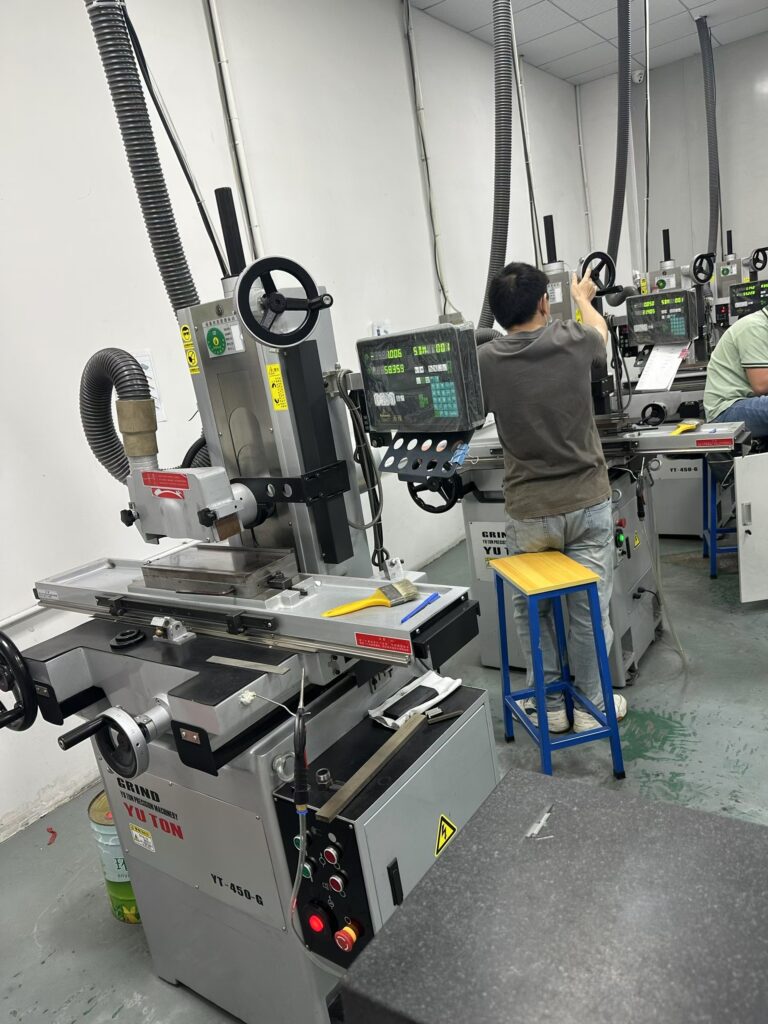
A manual surface grinder is also called a hand-feed surface grinder. This precision machine tool produces flat, parallel, and square surfaces. It works by passing a workpiece under a rotating abrasive wheel. Furthermore, the operator positions every axis through handwheels. No pumps, servos, or G-code are involved, unlike hydraulic or CNC grinders.
Core Components
At its heart, the machine is built around a horizontal spindle that holds the grinding wheel. Specifically, the wheel spins above a reciprocating table that carries the workpiece back and forth under the abrasive. In addition, a saddle provides cross-feed movement, while a vertical slide raises and lowers the wheelhead in precise increments. Meanwhile, the workpiece itself sits on a magnetic chuck, which clamps ferrous parts evenly without clamps or vise jaws. Bench-top models mount on a stand or sturdy workbench. Larger floor models stand on their own cabinet with a coolant tank. Consequently, the overall design has changed little in decades, because its simplicity is also its greatest strength.
How Hand-Feed Works
During operation, the operator cranks the table longitudinally and indexes the cross-feed per stroke. Moreover, the wheel feeds down in small increments measured in microns. For example, a finish pass often removes just two to five micrometers. The operator relies on feel and the downfeed dial graduations. Thus, the process is quiet, controllable, and almost entirely mechanical. As a result, no warm-up cycle or controller boot is needed. There is also no hydraulic fluid to change before the first part.
Accuracy You Can Achieve
In skilled hands, a well-maintained hand-feed grinder is highly accurate. It holds parallelism and flatness near ±0.005 mm over 300 mm of travel. Furthermore, surface finishes of Ra 0.2 to 0.8 µm are routine on hardened tool steel. Indeed, many toolrooms reserve their finest mold-base and die-block work for veterans on hand-feed machines. Handwheel feedback supports careful spark-out passes that automatic cycles cannot replicate.
Why Manual Surface Grinders Still Sell in 2026
Some buyers assume hand-feed machines belong to the last century; however, current order books tell a different story. In fact, demand has stayed resilient. The economics of small-batch grinding have not changed, for three key reasons.
Affordability and Low Maintenance
First, the purchase price is dramatically lower than any automated alternative. A new hand-feed grinder typically costs USD 1,800 to USD 8,000, depending on size and accessories. By contrast, a comparable hydraulic machine often starts above USD 10,000. In addition, running costs stay minimal because the machine uses a small spindle motor and no hydraulic power unit. Additionally, maintenance is equally straightforward. A typical shop only needs regular way oiling, wheel dressing, and chuck cleaning. Consequently, a well-kept hand-feed machine can remain productive for twenty years with almost no service calls.
Flexibility for Small Batches and Repair Work
Second, hand-feed machines are unmatched for quick, one-off jobs. Consider a mold repair that needs ten minutes of grinding. The machine is set up faster than a CNC program could be written. Moreover, the machines occupy only a few square meters. They fit beside a lathe or mill in the tightest workshop. Alternatively, many models run on standard single-phase power, which makes them practical for small facilities without industrial wiring.
Training and Skill Building
Third, these grinders remain the default teaching machine in vocational schools. Students learn abrasive machining fundamentals through their hands. They master feed rates, wheel selection, dressing, and spark-out instead of a screen. Furthermore, that tactile skill transfers directly to hydraulic and CNC machines. Employers actively seek graduates who trained on manual equipment. As a result, schools and training centers order hand-feed grinders every year, creating a stable, repeatable market for distributors.
Key Applications and Buyers for Hand-Feed Grinders
Hand-feed grinders serve a surprisingly wide range of customers. In particular, five buyer types drive most of the global volume. Understanding them helps end users and distributors choose the right specification.
Mold and Tool Shops
Mold and die shops rely on these machines every day. They grind die blocks, mold bases, punches, and stripper plates square and parallel. For example, a small toolroom may surface-grind a repaired cavity insert in the morning. Afternoon work might include a set of fixture components. Many such shops keep a hand-feed machine beside a larger hydraulic grinder. The small machine handles delicate, short work without tying up capacity. If this describes your operation, our dedicated surface grinder for toolroom page outlines the configurations toolmakers request most.
MRO and Repair Facilities
Maintenance and repair workshops value exactly the same flexibility. They grind worn machine ways, shim stock, bearing seats, and custom spacers. Most jobs need no drawing and only minutes of setup. Additionally, repair work frequently involves single pieces, where automated cycles offer no real advantage. Meanwhile, the low purchase price means the machine pays for itself after just a handful of repair jobs.
Schools, Job Shops, and Developing-Market Buyers
Vocational colleges and technical schools buy these grinders for their labs. Orders often arrive in batches of five to twenty units. Small fabricators and job shops in developing markets are the other volume buyers. The machines ship affordably, learn easily, and repair with local mechanics. Indeed, the same pattern holds across Southeast Asia, Africa, the Middle East, and South America. A hand-feed grinder is often the young workshop’s first precision grinding machine. For these owners, the machine also earns its keep. Paid grinding jobs pay for it long before automated equipment becomes affordable.
How to Choose a Hand-Feed Surface Grinder
Selecting the right model means matching table capacity, accuracy, and accessories to the work. However, buyers often over-specify, paying for capacity they never use, or under-specify and outgrow the machine within a year. The following criteria cover the decisions that matter most.
Table Size and Capacity
Table size is the starting point, because it determines the largest workpiece the machine can handle. Common sizes start at 150 × 450 mm (6 × 18 inches). Mid-size and large options run 200 × 500 mm and 250 × 600 mm (10 × 24 inches). Specifically, the 150 × 450 class suits small parts and compact shops. The 200 × 500 class covers most mold components. The 250 × 600 class handles larger die sets and fabrications. Furthermore, buyers should check the magnetic chuck dimensions first. The maximum table-to-wheel-centerline distance matters before ordering. When in doubt, choose one table size larger than your current largest part. Workpieces tend to grow as a business wins bigger contracts.
Accuracy Class and Chuck Options
Precision means guaranteed parallelism, flatness, and finish figures. The details live in our surface grinding tolerance guide, which explains every number. Standard-class machines suit general workshop work, while precision-class machines with hand-scraped ways suit gauge and mold work. Moreover, the chuck decision matters. A permanent magnetic chuck needs no power and never loses grip in an outage. An electromagnetic chuck offers variable force and easy demagnetization. Consequently, most small shops choose permanent chucks for reliability. Production-oriented shops prefer electromagnetic models instead. Buyers can compare both in our surface grinder magnetic chuck overview.
Essential Accessories
The right accessories turn a bare machine into a ready-to-run cell. For example, a precision toolmaker’s vise holds non-magnetic parts. A diamond dresser trues the wheel, and a balancing stand extends its life. In addition, an optical ruler or digital readout removes dial errors and speeds setup for new operators. A simple coolant setup supports fine finishing without heat checks. Thus, buyers should quote the accessory package up front rather than retrofitting later at higher cost.
Manual vs Hydraulic vs CNC: The Upgrade Path
Most shops eventually grow beyond hand feeding. That progression is a normal part of every grinding operation’s lifecycle. Therefore, it helps to understand where each technology fits before you buy.
Comparing the Three Technologies
A hand-feed machine wins on price, footprint, and simplicity for short runs. Hydraulic models automate table reciprocation and cross-feed. The change lifts output for repeat batches of ten or more identical parts. Furthermore, a CNC grinder automates every axis and can run unattended. It is the right choice for complex profiles and high-volume production.
| Feature | Manual | Hydraulic | CNC |
|---|---|---|---|
| Typical price (USD) | 1,800–8,000 | 10,000–30,000 | 30,000+ |
| Ideal batch size | 1–10 pieces | 10–100 pieces | 100+ pieces |
| Operator skill | Grinding feel | Moderate | Programming |
| Footprint | Small | Medium | Large |
| Maintenance | Minimal | Hydraulic service | Electronics and servos |
However, the choice is rarely permanent. Indeed, many successful shops start with a hand-feed machine and add hydraulic power as batches grow. CNC investment waits until the order book justifies it. For a deeper breakdown, see our CNC versus manual surface grinder comparison. It walks through tolerance, cycle time, and labor cost side by side.
When and How to Upgrade
Upgrade when batches grow beyond what an operator can comfortably hand-feed. The same applies when you start quoting repetitive production work. In particular, watch for one clear signal. If a single job repeats beyond fifty pieces a month, powered feeds pay back within a year. At that stage, buyers should explore our hydraulic surface grinder range. Buyers should also compare our automatic surface grinder models, which share the same precision with powered feeds. Consequently, distributors benefit as well, because today’s hand-feed buyer is often tomorrow’s hydraulic and CNC customer.
Why Distributors Start With Manual Grinders — The YUTON Lineup
For machinery distributors, choosing a first product line is a strategic decision, and hand-feed grinders check almost every box. That is why they anchor dealer catalogs from Eastern Europe to East Africa.
Why Manual Grinders Are the Ideal Entry Product
First, the price point makes selling easy. Low capital cost means short approval cycles for buyers and fast stock turns for dealers. In addition, the machines pack into compact crates. They ship by LCL or mixed container and need no special rigging on arrival. Moreover, reliability is high and warranty claims are rare, because there are few electronic parts to fail. Specifically, consider a dealer who places ten manual machines in local mold shops in year one. By year three, two or three of those accounts often upgrade to hydraulic grinders. Finally, every hand-feed customer becomes a relationship that can grow into hydraulic and CNC sales. In many markets, the small grinder acts as a door-opener that starts a decade-long equipment partnership.
Inside the YUTON Factory
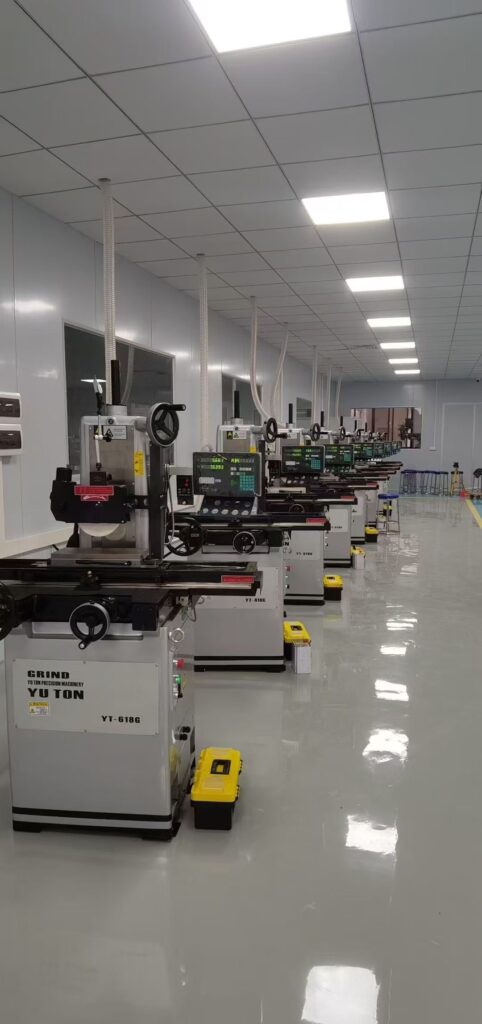
YUTON operates under Guangdong Yutong Precision Machinery Co Ltd. We manufacture in Dongguan, the heart of China’s machine-tool supply basin. Our facility spans roughly 15,000 square meters across seven factory buildings. It employs about 150 people, including technicians, scraping craftsmen, and QC engineers. Furthermore, we build to the ISO 9001 quality management standard and CE marking requirements. Every machine also ships with a geometry inspection report. Indeed, our spindles, precision bearings, and drive units come from leading Japanese, Taiwanese, and American suppliers. That sourcing is why our accuracy holds up after years of single-shift use. In 2025 alone, YUTON shipped approximately 3,100 surface grinders. That volume places us among China’s top three manufacturers by unit volume. Consequently, overseas partners receive the same build quality whether they order one sample machine or a full 40-foot container.
The YUTON Lineup and Partnership Program
Our catalog covers the full upgrade path, from compact 150 × 450 to 250 × 600 mm hand-feed grinders. It extends through large hydraulic saddle-type and column-type surface grinders. For indicative budgets, the surface grinder price page lists typical price ranges. Meanwhile, our surface grinders for sale page shows stock models ready for quick shipment. Additionally, we support distributors with English manuals, spare-part kits, factory training, and territory protection. As a result, partners can quote confidently and grow with us. Our machines already run in Japan, Southeast Asia, Europe, and the Americas. Industry data from the Association for Manufacturing Technology supports this view. Reporting in Modern Machine Shop confirms entry-level grinding remains a resilient category. Furthermore, the Society of Manufacturing Engineers continues to emphasize manual machining fundamentals. Its skills and training content keeps hand skills at the core.
FAQ: Manual Surface Grinder
What is the difference between a manual and a hydraulic surface grinder?
On a manual surface grinder, the operator controls all three axes through handwheels. These cover table travel, cross-feed, and downfeed. A hydraulic grinder uses a power unit to drive the same motions automatically. Therefore, hydraulic machines suit repeated batches, whereas hand-feed models suit one-offs, repairs, and training work. Furthermore, hydraulic models cost more to buy but need less operator effort over long production runs.
How accurate is a manual surface grinder?
A properly aligned hand-feed grinder routinely holds ±0.005 mm parallelism and flatness over 300 mm of travel. Surface finishes near Ra 0.4 µm are achievable on hardened steel. However, the achieved accuracy depends heavily on operator skill, wheel condition, and the machine’s maintenance history. In addition, precision-class machines with hand-scraped ways and factory inspection reports deliver the most consistent results.
How much does a manual surface grinder cost?
Entry-level bench models start around USD 1,800. Larger 250 × 600 mm floor models with precision chucks and readouts reach USD 7,000 to 8,000. Moreover, prices vary with table size, chuck type, accessory package, and destination port. Consequently, buyers should request a formal quotation rather than relying on generic list prices.
Can a manual surface grinder grind non-magnetic workpieces?
Yes, but the standard magnetic chuck only clamps ferrous metals. Stainless steel, carbide, aluminum, or plastic parts need different workholding. Operators use a toolmaker’s vise, a vacuum chuck, or a sine plate with laminated parallels. Alternatively, a double-sided magnetic vise block can secure small non-ferrous parts during light grinding operations.
Does YUTON support overseas distributors of hand-feed grinders?
Yes. YUTON supplies hand-feed grinders and complete hydraulic lines to distributors worldwide. Every package includes English documentation, spare-part kits, training, and territory protection. Furthermore, distributors can start with a single sample machine and scale into container orders as local demand grows. In addition, our export team guides partners through specification selection, shipping documentation, and after-sales setup. Thus, a new partner can be fully operational within weeks of first contact.
Conclusion
The manual surface grinder is far from obsolete. Indeed, it remains the most affordable and teachable route into precision flat grinding for shops, schools, and repair shops worldwide. Moreover, for distributors it is the perfect entry product—cheap to stock, easy to ship, and simple to support. A built-in upgrade path leads toward hydraulic and CNC machines.
Are you an end user? Send us your workpiece size, material, and target tolerance, and our engineers will quote a complete package. Alternatively, do you distribute machinery in your region? Contact YUTON today to become a distributor, request sample pricing, and secure your territory.