
AI Summary: Surface grinding for aerospace and medical manufacturing represents the highest tier of precision machining requirements. From Inconel 718 turbine components to cobalt-chrome orthopedic implants, these industries demand micron-level tolerances, zero-defect surface integrity, and full material traceability. This article examines the unique grinding challenges of aerospace and medical applications in 2026, the advanced technologies — including in-process metrology, ductile-regime grinding, and cryogenic cooling — that address them, and how manufacturers can select the right surface grinder to meet these exacting standards.
Aerospace and medical device manufacturing occupy the most demanding end of the precision machining spectrum. In aerospace, a single micro-crack in a turbine blade grinding operation can lead to catastrophic engine failure. In medical manufacturing, a surface finish deviation on an orthopedic implant can cause premature wear, tissue inflammation, or implant loosening in the patient. The margin for error in both industries is effectively zero, and surface grinding is the process that ultimately determines whether a component meets or fails its specification.
At YUTON Surface Grinder, we have spent more than 20 years building CE-certified grinding machines that serve manufacturers across more than 30 countries. Our product line — including automatic surface grinders, hydraulic surface grinders, manual surface grinders, and CNC surface grinders — is engineered to deliver the mechanical stability, thermal consistency, and positioning accuracy that aerospace and medical component grinding demand. In this article, we explore the key trends and technical requirements defining surface grinding for aerospace and medical industries in 2026.
1. Why Aerospace and Medical Demand the Highest Grinding Precision
The common thread between aerospace and medical manufacturing is that component failure carries life-safety consequences. This reality shapes every aspect of the grinding process, from material selection and wheel specification to coolant chemistry and final inspection protocols. Surface grinding for aerospace and medical applications is not simply about achieving a smooth finish — it is about guaranteeing that the subsurface layer, the surface roughness profile, and the dimensional accuracy all meet specifications that have been validated through extensive testing and regulatory review.
In aerospace, the primary materials are nickel-based superalloys (Inconel 718, Rene 41), titanium alloys (Ti-6Al-4V), and increasingly, ceramic matrix composites (CMCs). These materials are selected for their high-temperature strength and corrosion resistance, but they are notoriously difficult to machine. Grinding induces heat, and heat induces thermal damage — including rehardening burns, temper burns, and residual tensile stress — all of which can initiate fatigue cracks in service. Controlling the grinding process to avoid these outcomes requires machines with exceptional rigidity, precise spindle control, and advanced coolant delivery systems.
In medical manufacturing, the dominant material is cobalt-chrome (CoCr) alloy for joint replacement implants, along with titanium alloys for trauma plates and surgical instruments. CoCr is extremely work-hardening; conventional machining causes rapid tool wear and poor surface finish. Surface grinding, particularly with diamond-abrasive wheels, produces the mirror-like finishes (Ra < 0.025 µm) required for biocompatibility and low friction articulation in hip and knee implants. According to the Society of Manufacturing Engineers (SME), the medical device sector’s demand for precision-ground components is growing at 12% annually, driven by aging populations and the expansion of minimally invasive surgical tools.
2. Aerospace Surface Grinding: Materials, Challenges, and Solutions
Aerospace surface grinding in 2026 is defined by the need to process next-generation materials at production volumes while maintaining zero-defect quality. The industry’s transition toward more electric aircraft (MEA), open-rotor engines, and hypersonic flight is driving demand for components that operate at higher temperatures and stresses than previous generations, requiring advanced materials and correspondingly advanced grinding processes.
2.1 Inconel and Titanium: The Grinding Challenge
Inconel 718 work-hardens rapidly when machined with inadequate cooling or excessive feed rates. In surface grinding, this manifests as wheel loading (where material particles become embedded in the wheel bond) and rapid wheel wear, both of which degrade surface finish and dimensional accuracy. The solution employed by leading aerospace suppliers in 2026 involves a combination of high-pressure coolant delivery (typically 70+ bar), continuous-dress creep-feed grinding (CDCF), and wheel-speed optimization to maintain a consistent cutting action rather than a rubbing or ploughing action.
Titanium alloys present a different challenge: they have low thermal conductivity, meaning grinding heat concentrates at the wheel-workpiece interface rather than dissipating into the workpiece. This can cause alpha-case formation — a hardened surface layer that is difficult to remove and compromises fatigue performance. Aerospace manufacturers address this through cryogenic grinding (using liquid nitrogen as a coolant) or through Minimum Quantity Lubrication (MQL) with carefully formulated esters that provide both cooling and lubrication. Both approaches require grinding machines with sealed spindles and corrosion-resistant components — design features that are standard on YUTON’s CNC surface grinder series.
2.2 Ceramic Matrix Composites (CMCs) and Ductile-Regime Grinding
Ceramic matrix composites are replacing nickel superalloys in the hottest sections of jet engines because they offer equivalent high-temperature strength at approximately one-third the weight. However, CMCs are brittle and prone to subsurface micro-cracking during grinding. The solution is ductile-regime grinding — a process in which the depth of cut is controlled to be smaller than the material’s critical chip thickness, causing the ceramic to deform plastically rather than fracturing. Achieving ductile-regime grinding requires machines with sub-micron positioning resolution, aerostatic spindles with minimal vibration, and real-time force feedback to maintain the correct depth of cut. These are not capabilities found on general-purpose surface grinders; they require machines designed from the ground up for ultra-precision applications.
The International Organization for Standardization (ISO) has published detailed guidance on grinding process validation for aerospace components (ISO 16090 series), and compliance with these standards is increasingly a contractual requirement for aerospace suppliers. Surface grinding machines used in aerospace production must be capable of generating the process validation data — including wheel wear curves, thermal profiles, and surface integrity measurements — that these standards demand.
3. Medical Device Surface Grinding: Implants, Instruments, and Biocompatibility
Medical device surface grinding has distinct priorities compared to aerospace. While aerospace focuses on high-temperature strength and fatigue resistance, medical grinding prioritizes surface finish, dimensional accuracy for press-fit assembly, and the complete absence of embedded abrasive particles that could cause inflammation in the patient. A cobalt-chrome knee implant with a surface roughness of Ra 0.05 µm will articulate smoothly against the ultra-high-molecular-weight polyethylene (UHMWPE) tibial insert for 15 to 20 years; the same implant with Ra 0.2 µm may fail within 5 years due to accelerated wear.
3.1 Cobalt-Chrome Grinding for Orthopedic Implants
Cobalt-chrome alloys work-harden so rapidly that conventional abrasive grinding is ineffective; diamond-abrasive wheels are mandatory. The grinding process for orthopedic implants typically involves rough grinding to remove cast or forged irregularities, semi-finish grinding to approach final dimensions, and finish grinding with progressively finer diamond grits to achieve the mirror finish. Throughout this process, coolant cleanliness is critical — a single particle of embedded abrasive or metallic swarf can create a surface defect that becomes a nucleation site for wear or corrosion in vivo. Medical device manufacturers address this through multi-stage filtration systems and regular coolant monitoring, processes that are integrated into the operation of hydraulic surface grinders used in medical production cells.
In 2026, the dominant trend in medical implant grinding is the adoption of automated production cells that combine surface grinding with in-process metrology and automated part washing. A typical cell loads raw CoCr blanks from a pallet, grinds the articulating surfaces to final dimensions and finish, measures critical dimensions using touch-probe or laser metrology, washes the part to remove all coolant residue, and deposits the finished implant into a sealed, traceable packaging container — all without human intervention. This level of automation is essential not only for cost control but also for traceability compliance with FDA and EU MDR (Medical Device Regulation) requirements.
3.2 Surgical Instruments and Tooling
Beyond implants, surface grinding plays a critical role in manufacturing surgical instruments — forceps, retractors, scalpel handles, and minimally invasive surgery (MIS) tools. These instruments require sharp edges, precise flat surfaces for mating, and corrosion-resistant finishes. Stainless steel surgical instruments are typically ground using aluminum oxide or silicon carbide wheels, with careful control of grinding parameters to avoid overheating that could compromise corrosion resistance. The trend in 2026 is toward multi-axis surface grinding centers that can process complex 3D geometries in a single setup, reducing handling and improving consistency across production batches.
As reported by Modern Machine Shop, the convergence of aerospace and medical manufacturing requirements is driving demand for “dual-qualified” surface grinding machines that can meet both AS9100 (aerospace quality management) and ISO 13485 (medical device quality management) standards. Manufacturers that can demonstrate compliance with both standards have a significant competitive advantage in securing contracts from tier-1 aerospace and medical OEMs.
4. Key Technologies for 2026: In-Process Metrology and Smart Grinding
Two technologies are transforming surface grinding for aerospace and medical applications in 2026: in-process metrology and AI-driven process optimization. Both address the same fundamental challenge — how to guarantee part quality without removing the part from the machine for inspection, which introduces handling risk and cycle-time penalties.
In-process metrology uses non-contact sensors — typically laser triangulation or white-light interferometry — to measure surface roughness, flatness, and dimensional accuracy while the part remains fixtured on the machine. The measurement data feeds directly to the CNC controller, which can make real-time adjustments to compensate for wheel wear, thermal drift, or material hardness variations. For aerospace components with complex curvature, in-process metrology also verifies that the grinding wheel is following the programmed path correctly, preventing scrap caused by programming errors or tool-path deviations.
AI-driven process optimization builds on in-process metrology by adding predictive capability. Machine learning models trained on historical grinding data can predict wheel-dulling events, thermal damage risk, and dimensional drift before these events occur. The system then preemptively adjusts grinding parameters — reducing feed rate, increasing coolant flow, or triggering a dressing cycle — to maintain process stability. For medical implant production, where a single scrapped part can represent hundreds of dollars in material and dozens of hours of cycle time, this predictive capability delivers measurable ROI.
YUTON’s automatic surface grinder and CNC series are designed with the sensor integration points and data-communication protocols needed to support these advanced capabilities. As the industry continues to adopt smart manufacturing technologies, having a grinding machine with open-architecture controls and standardized data interfaces (such as OPC UA or umati) is becoming a key selection criterion for aerospace and medical manufacturers.
5. Selecting the Right Surface Grinder for Aerospace and Medical Work
Choosing a surface grinder for aerospace or medical applications is a decision that extends far beyond table size and spindle horsepower. These industries require machines that can demonstrate process capability (Cpk > 1.33 is typical), generate validated process documentation, and maintain accuracy over extended production runs. The following are the key selection criteria that YUTON recommends for aerospace and medical grinding applications.
First, machine rigidity and vibration damping are non-negotiable. Both aerospace superalloys and medical CoCr alloys require consistent cutting action, and any vibration or deflection in the machine structure will be transferred to the workpiece surface, creating chatter marks or surface roughness variations. Machines with polymer-concrete (mineral casting) bases or heavily ribbed Meehanite cast-iron construction provide the damping characteristics needed for these materials. YUTON surface grinders use hand-scraped guideways and stress-relieved castings to achieve the stability that aerospace and medical grinding demand.
Second, thermal management is critical. Grinding generates heat, and heat causes dimensional drift. In aerospace production, where parts may be ground in multiple setups over several hours, thermal stability of the machine tool is essential to maintain inter-setup dimensional consistency. Look for machines with temperature-compensated scales, cooled hydraulic systems, and spindle bearings with controlled preload. For the most demanding applications, CNC surface grinders with environmental enclosures and active thermal compensation provide the highest level of dimensional stability.
Third, consider the control system and data capabilities. Aerospace and medical manufacturing both require extensive process documentation for quality management system compliance. A surface grinder with a modern CNC controller that logs grinding parameters, wheel identification, coolant conditions, and dimensional measurements provides the data foundation for traceability and process validation. YUTON’s CNC surface grinder series supports data logging and remote monitoring, enabling integration with manufacturing execution systems (MES) and enterprise resource planning (ERP) platforms.
Finally, evaluate the service and support infrastructure. Aerospace and medical production schedules are often tightly coupled to aircraft delivery schedules or surgical procedure planning; unplanned machine downtime is not acceptable. Selecting a surface grinder from a manufacturer with a proven global service network, readily available spare parts, and technical support staff who understand aerospace and medical grinding requirements is as important as the machine’s technical specifications. YUTON’s international export experience across more than 30 countries ensures that our customers receive responsive support wherever they are located.
6. Frequently Asked Questions
What makes surface grinding for aerospace different from general machining?
Surface grinding for aerospace differs from general machining in three key ways: the materials (Inconel, titanium, CMCs) are extremely difficult to machine and require specialized wheels and parameters; the tolerances are typically ±0.005 mm or tighter; and the process must be fully validated and documented to comply with aerospace quality standards such as AS9100 and ISO 16090.
Why is surface finish so critical for medical implants?
Surface finish is critical for medical implants because a rough surface increases friction against the opposing implant component (typically UHMWPE), generating wear particles that can cause inflammation and implant loosening. A mirror finish (Ra < 0.025 µm) minimizes wear and extends implant service life, which is essential for patient outcomes and regulatory approval.
Can a general-purpose surface grinder be used for aerospace or medical work?
A general-purpose surface grinder may be used for prototype or non-critical aerospace and medical components, but production parts typically require machines with higher rigidity, thermal stability, and data-logging capabilities. Aerospace and medical quality management systems also require that the grinding machine be included in the validated production process, which generally necessitates a CNC or at minimum a fully programmable automatic surface grinder.
What is ductile-regime grinding and when is it used?
Ductile-regime grinding is a precision grinding technique that maintains the depth of cut below the material’s critical chip thickness, causing brittle materials (such as ceramics and CMCs) to deform plastically rather than fracturing. It is used for ceramic matrix composites in aerospace engines and for advanced ceramic medical components, and it requires ultra-precision surface grinders with sub-micron positioning resolution.
How does in-process metrology improve surface grinding quality?
In-process metrology improves surface grinding quality by measuring the workpiece while it is still fixtured, detecting dimensional drift or surface finish degradation in real time, and feeding that data to the CNC controller for immediate compensation. This eliminates the delay and risk of the traditional measure-then-adjust loop and enables consistent quality across long production runs.
Published by YUTON Surface Grinder — https://surfacegrindermfg.com. All rights reserved.
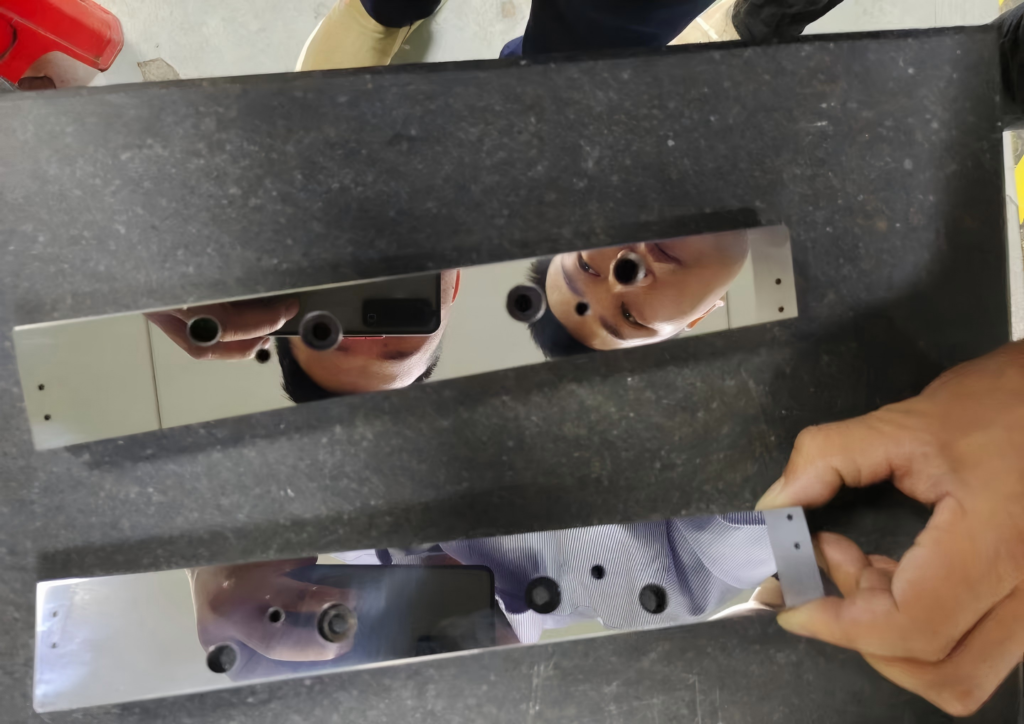
This CNC surface grinder achieves Ra < 0.025 µm mirror finishes on cobalt-chrome orthopedic implants and high-temperature aerospace alloys. Consistent, defect-free surfaces are critical to implant longevity and flight safety.