
Nano precision grinding pushes surface finishing beyond the micrometer barrier into the nanometer regime. Therefore, manufacturers in semiconductors, optics, and medical devices increasingly rely on this technology to achieve Ra values below 10 nm — and sometimes approaching 0.5 nm.
What Is Nano Precision Grinding?
Nano precision grinding refers to grinding processes that achieve surface roughness values in the nanometer range (Ra < 10 nm) and dimensional tolerances at the sub-micron level. Moreover, unlike conventional surface grinding — which typically achieves Ra 0.2–0.8 μm — nano precision grinding demands specialized machine structures, ultra-fine abrasives, and precisely controlled process parameters.
The distinction matters because conventional grinding introduces a subsurface damage layer of 5–15 μm. However, nano precision grinding limits this damage layer to below 1 μm, making it essential for thin, brittle substrates that cannot tolerate internal stress. Therefore, applications such as silicon wafer thinning, SiC substrate planarization, and optical lens finishing require this level of control. A quality https://surfacegrindermfg.com/manual-surface-grinder/ can serve as the starting point before upgrading to nano-level capability.
Key Specifications That Define Nano Precision Grinding
The following parameters distinguish nano precision grinding from conventional precision grinding:
- Surface roughness: Ra < 10 nm (compared to 200–800 nm for conventional grinding)
- Flatness: ≤ 0.5 μm over 100 mm (compared to 2–5 μm typical)
- Subsurface damage depth: < 1 μm (compared to 5–15 μm)
- Positional accuracy: ± 0.05 μm or better
- Machine structural stiffness: > 100 N/μm loop stiffness
Consequently, achieving these specifications requires purpose-built equipment and carefully engineered process chains.
Five Technology Enablers for Nano Precision Grinding
Understanding the technology stack helps you evaluate equipment and plan process upgrades. Moreover, each enabler addresses a specific challenge in the nano grinding regime.
1. Ultra-Rigid Machine Structures
Nano precision grinding demands machine structures with exceptional static and dynamic stiffness. Furthermore, conventional cast iron beds — while adequate for standard precision grinding — may deflect enough at sub-micron infeeds to compromise flatness. Therefore, nano grinding machines often use granite or ceramic-composite bases with 3–5 times the damping capacity of cast iron.
Granite’s low thermal expansion coefficient (4–8 × 10⁻⁶/°C, versus 10–12 × 10⁻⁶/°C for cast iron) also reduces thermal drift during long grinding cycles. In addition, the natural damping of granite suppresses vibration modes that would otherwise imprint chatter marks at the nanometer scale.
2. Nanometer-Scale Motion Control
Positioning at the nanometer scale requires linear motors or piezoelectric actuators with sub-nanometer resolution. Moreover, air-bearing guide ways — which eliminate mechanical contact and stiction — enable smooth, frictionless motion that ball screws cannot match below 0.1 μm.
The control loop bandwidth must exceed 1 kHz for chatter suppression, and the encoder resolution should reach 0.1 nm or better. Furthermore, thermal drift compensation algorithms using real-time temperature data from multiple sensors keep the positioning error below 0.05 μm over an 8-hour shift (https://www.mmsonline.com/).
3. Ultra-Fine Abrasive Wheels and Slurries
Wheel selection is critical for nano precision grinding. Furthermore, the abrasive type, grit size, and bond system must match the workpiece material:
- Single-crystal diamond wheels (grit 3000–10000) for ceramics and glass
- Cubic boron nitride (CBN) wheels (grit 1500–5000) for hardened steels and superalloys
- Nanodiamond slurries for CMP-based finishing, where spherical detonation nanodiamonds (3–10 nm particle size) achieve Ra values down to 0.5 nm on SiC wafers without micro-scratches
In addition, resin-bonded wheels are preferred over metal bonds for thin, brittle substrates because they produce less aggressive cutting forces and shallower subsurface damage.
4. In-Process Metrology and Feedback
Nano precision grinding cannot rely on post-process inspection alone. Therefore, in-process measurement systems — including laser interferometers, capacitive displacement sensors, and on-machine probes — provide real-time feedback that enables closed-loop compensation.
Research published in 2026 demonstrates cup-wheel concentric grinding where adaptive error compensation based on on-machine measurement reduced form error PV from 57.7 μm to 0.3 μm in a single correction cycle. Furthermore, this level of correction is only achievable when measurement and grinding are integrated into a single feedback loop (https://www.sme.org/).
5. Environmental and Thermal Control
At the nanometer scale, thermal expansion becomes a dominant error source. Moreover, a 1°C temperature change in a 500 mm granite beam causes approximately 2–4 nm of expansion — comparable to the surface roughness target. Therefore, nano precision grinding requires:
- Temperature-controlled enclosures maintaining ±0.1°C stability
- Coolant temperature regulation within ±0.5°C
- Vibration isolation through air-spring or active isolation platforms
- Clean air environment (ISO Class 5–7) to prevent particle contamination
Consequently, the total facility investment for nano precision grinding often exceeds the machine cost alone (https://www.amtonline.org/).
Material-Specific Nano Grinding Strategies
Different materials demand different approaches. Moreover, applying the wrong strategy to a sensitive material can cause catastrophic yield loss.
Silicon and Compound Semiconductors (SiC, GaN)
Silicon carbide wafers — with Mohs hardness of 9.5, second only to diamond — represent one of the most challenging nano grinding applications. Furthermore, conventional in-feed grinding creates a uniform stress layer that causes wafer bow and warp, sometimes described as a “potato chip” shape. Therefore, cross-feed grinding with 50% step-over is recommended, producing a checkerboard stress pattern that cancels itself out.
Documented results show switching from in-feed to cross-feed grinding on 6-inch SiC wafers reduced total thickness variation (TTV) from 3.2 μm to 1.1 μm. Moreover, catalyst-assisted CMP as a finishing step can achieve Ra ≈ 0.05 nm on SiC, approaching the atomic limit.
Ceramics and Optical Glass
Aluminum nitride (AlN), alumina, and zirconia substrates are brittle and prone to edge chipping. Furthermore, the “spring-back” paradox applies: grinding introduces compressive stress into thin substrates, and when the part is released from the chuck, it warps. Therefore, a three-phase strategy is essential:
- Coarse removal: 400-grit diamond, 15 μm depth of cut
- Fine finishing: 1200-grit diamond, 3 μm depth of cut
- Stress-relief pass: 3000-grit diamond, 0.5 μm depth of cut — specifically designed to remove the damage layer from Phase 2
This approach has reduced scrap rates from 30% to 2% on thin AlN substrates for RF amplifier applications. Moreover, the same phased strategy applies on hydraulic surface grinders like https://surfacegrindermfg.com/hydraulic-surface-grinder/ when combined with fine-grit wheel upgrades.
Hardened Tool Steels and Superalloys
For metallic workpieces, CBN wheels in resin or vitrified bonds achieve Ra 10–50 nm with proper parameter control. Furthermore, the key is maintaining consistent grinding force and preventing thermal damage, which becomes progressively harder as the target Ra decreases. Therefore, adaptive grinding control systems that monitor spindle power and adjust feed rate in real time are increasingly paired with nano grinding machines.
Practical Implementation: From Conventional to Nano Precision
Most shops do not start with a dedicated nano grinding machine. However, a phased approach can bridge the gap between conventional precision (Ra 0.2–0.8 μm) and nano precision (Ra < 10 nm).
Phase 1: Optimize Your Existing Process
Start by maximizing the precision of your current surface grinder. Furthermore, this includes:
- Replacing worn spindle bearings and checking runout
- Calibrating the magnetic chuck flatness to within 1 μm
- Switching to finer-grit wheels (500–1000 grit)
- Implementing strict thermal management (coolant temperature control, warm-up cycles)
Therefore, many shops achieve Ra 50–100 nm on their existing machines with these steps alone (https://surfacegrindermfg.com/hydraulic-surface-grinder/).
Phase 2: Add Precision Measurement Capability
Install an on-machine probe or laser displacement sensor to measure flatness and parallelism without removing the workpiece. Moreover, this enables you to detect and correct errors during the grinding cycle rather than discovering them at final inspection.
Phase 3: Invest in Dedicated Nano Grinding Equipment
When your application demands Ra < 50 nm consistently, a purpose-built nano grinding machine becomes necessary. Furthermore, these machines feature granite bases, air-bearing guides, linear motors, and temperature-controlled enclosures — capabilities that cannot be retrofitted to a conventional grinder.
Why YUTON Builds the Foundation for Precision Advancement
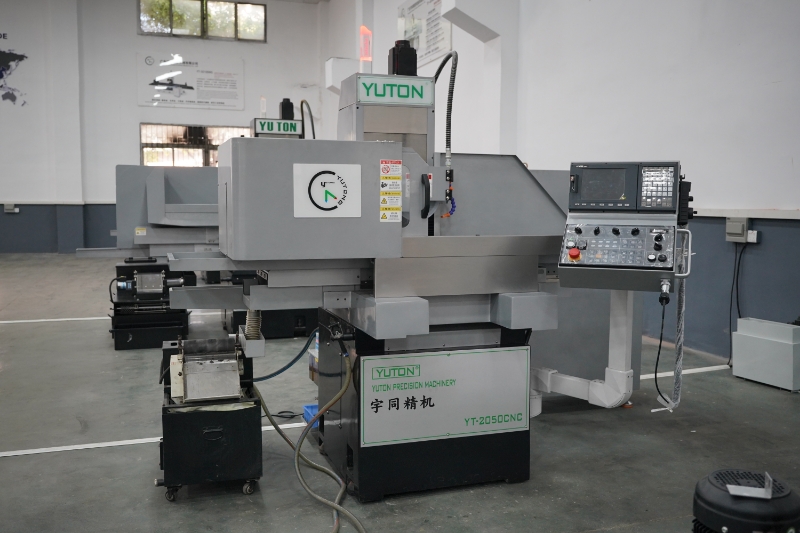
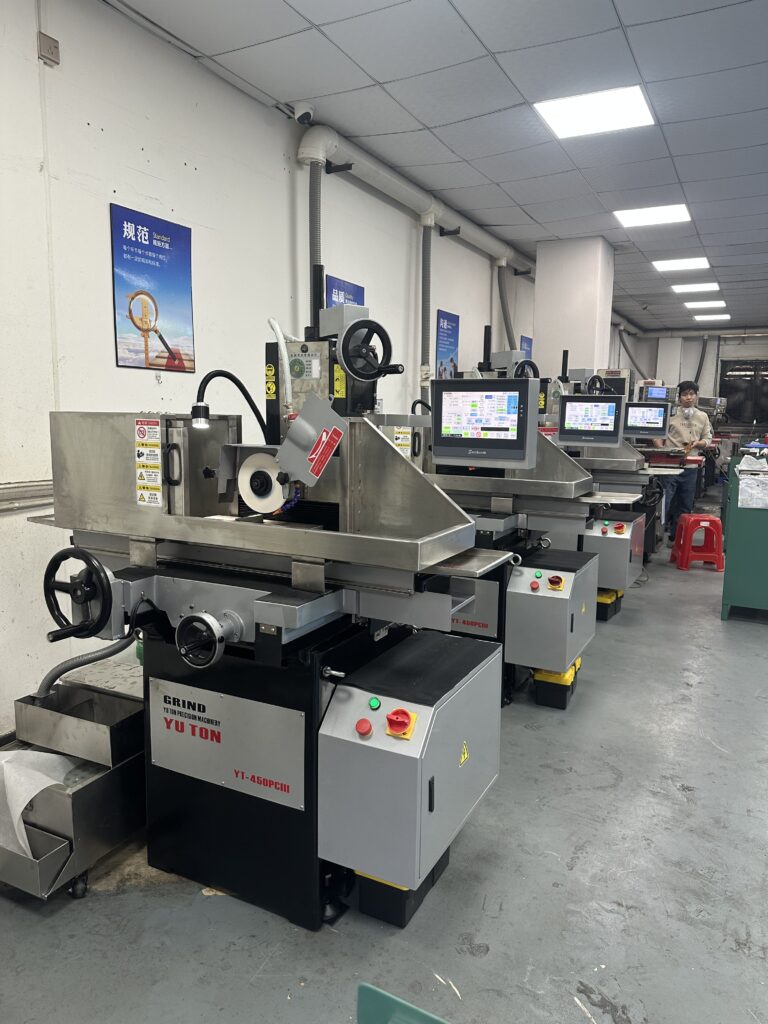
While dedicated nano grinding machines represent the ultimate precision tier, YUTON surface grinders provide the essential foundation that makes precision advancement practical. Furthermore, our machines offer several advantages for shops moving toward tighter tolerances:
- Meehanite cast iron construction with superior damping characteristics provides the vibration control that supports fine-grit wheel operation and sub-micron infeed stability.
- Japanese, Taiwanese, and American core components deliver the spindle accuracy and feed resolution that precision grinding demands.
- ISO 9001 + CE certification ensures every machine from our 15,000 m² Dongguan facility meets documented quality standards — the discipline that nano-level work requires (https://www.iso.org/). Furthermore, CE compliance demonstrates conformity with European safety and electromagnetic compatibility directives essential for precision equipment (https://ec.europa.eu/).
- 3,100 units sold in 2025, ranking YUTON among China’s top three surface grinder manufacturers. Moreover, this production scale ensures consistent quality and the manufacturing depth to support custom specifications.
- CNC, PLC hybrid, and manual models allow you to match the control architecture to your precision journey — from manual toolroom work to CNC-controlled multi-pass cycles (https://surfacegrindermfg.com/automatic-surface-grinder/). For CNC-specific capabilities, see https://surfacegrindermfg.com/cnc-surface-grinder/.
Discover our full range at https://surfacegrindermfg.com/ — and learn how a YUTON surface grinder can be your first step toward nano-level precision.
FAQ: Nano Precision Grinding
What is nano precision grinding?
Nano precision grinding is a grinding process that achieves surface roughness below Ra 10 nm and dimensional tolerances at the sub-micron level. Furthermore, it requires ultra-rigid machine structures, nanometer-scale motion control, and specialized abrasive systems to minimize subsurface damage.
How is nano precision grinding different from conventional grinding?
Conventional grinding achieves Ra 0.2–0.8 μm with subsurface damage of 5–15 μm. However, nano precision grinding targets Ra < 10 nm with damage layers below 1 μm. Therefore, it requires granite or ceramic machine bases, air-bearing guides, linear motors, and temperature-controlled environments.
What materials require nano-level grinding?
Silicon wafers, silicon carbide substrates, optical glass, ceramics (AlN, alumina, zirconia), and medical-grade implants typically require nano precision grinding. Moreover, any application where surface quality directly affects device performance — semiconductor fabrication, precision optics, and medical devices — benefits from this technology.
Can I achieve nano-level results on a standard surface grinder?
You can improve surface finish significantly on a standard grinder — potentially reaching Ra 50–100 nm with optimized parameters, fine-grit wheels, and strict thermal management. However, consistent Ra < 10 nm results require a dedicated nano grinding machine with granite base, air bearings, and environmental control.
What does a nano-level grinding machine cost?
Nano precision grinding machines typically cost 3–10 times more than conventional precision surface grinders, with prices ranging from $150,000 to over $1 million depending on workpiece size, axis configuration, and metrology integration. Furthermore, facility preparation (temperature control, vibration isolation, clean air) can add 20–50% to the total investment.
Conclusion
Nano precision grinding represents the frontier of surface quality — where roughness is measured in nanometers and flatness in fractions of a micron. Therefore, manufacturers serving semiconductors, optics, and medical markets must understand the technology enablers, material-specific strategies, and implementation pathways to compete effectively.
The journey from conventional precision to nano precision is progressive. Moreover, shops can start by optimizing their existing surface grinders, adding measurement capability, and then investing in dedicated equipment when the application demands it. YUTON’s precision-built surface grinders — with Meehanite cast iron construction, Japanese/Taiwanese/American core components, and ISO 9001 + CE certification — provide the reliable foundation that makes this progression practical.
Explore YUTON surface grinders at https://surfacegrindermfg.com/ — CNC, automatic, hydraulic, and manual models built for precision advancement, backed by 150 people, 15,000 m² of production capacity, and 3,100 units delivered in 2025.