
A digital twin grinding machine creates a real-time virtual replica of your physical grinder, enabling simulation, optimization, and predictive maintenance before you ever cut metal. Therefore, this guide explains how digital twin technology works, what benefits it delivers, and how to implement it on your https://surfacegrindermfg.com/cnc-surface-grinder/ or other precision grinding equipment.
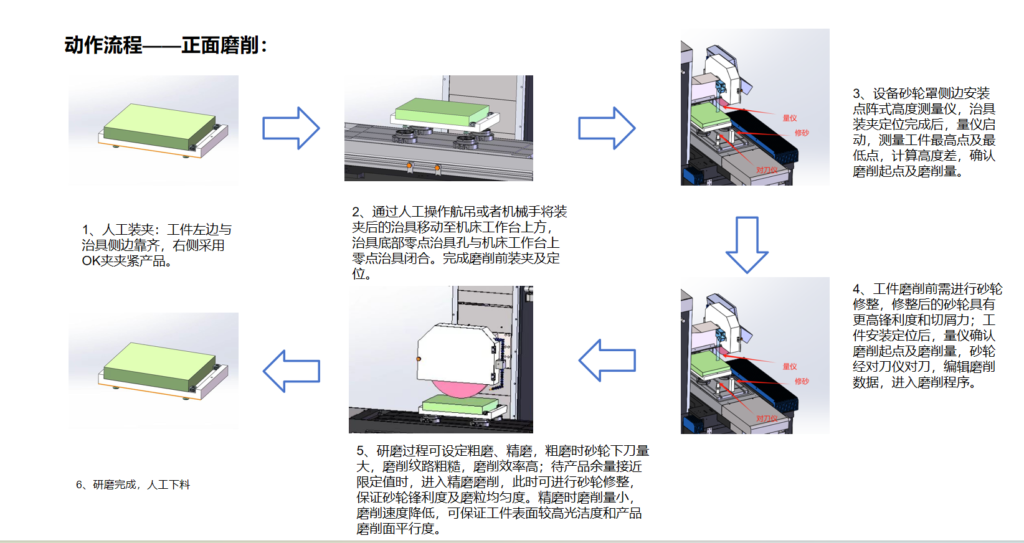
What Is a Digital Twin Grinding Machine
A digital twin is a dynamic virtual model that mirrors a physical machine throughout its lifecycle. Furthermore, unlike static CAD models or offline simulations, a digital twin grinding machine continuously receives data from sensors on the real machine — spindle vibration, motor current, wheel wear, temperature, and position — and updates the virtual model in real time. Consequently, the twin can predict how the physical machine will behave under different conditions, detect anomalies before they cause downtime, and optimize parameters without risking scrap on the shop floor.
Moreover, the concept has moved from research labs to production floors. At GrindingHub 2026 in Stuttgart, digital twin technology was identified as a central trend, with exhibitors demonstrating virtual commissioning, process monitoring, and AI-driven optimization as integrated solutions rather than standalone tools. In addition, Kellenberger presented a fully integrated Digital Twin of its TM300 turn-mill center at AMB 2026, developed with Siemens, allowing visitors to simulate and validate processes before producing the first workpiece.
How Digital Twin Technology Works in Grinding
Understanding the digital twin grinding machine requires looking at three layers that work together.
Sensor Data Acquisition
The physical grinding machine must be equipped with sensors that capture its operating state. Furthermore, key sensor types include:
- Vibration sensors (accelerometers): Mounted on spindle housings and workheads, sampling at 10–50 kHz to detect bearing defects, imbalance, and chatter frequencies
- Current sensors: Measuring spindle motor current to infer cutting forces and wheel loading, typically at 1 kHz sampling rate
- Temperature sensors: Monitoring spindle bearings, coolant, and workpiece surface temperature to predict thermal drift
- Position encoders: High-resolution linear and rotary encoders (0.001 mm resolution) tracking actual axis positions versus commanded positions
Moreover, these sensors generate 10–100 MB of data per hour of grinding, which the digital twin ingests continuously.
Virtual Model Synchronization
The digital twin maintains a physics-based model of the grinding machine that includes its structural dynamics, thermal behavior, and kinematic chain. Furthermore, this model is calibrated against the real machine during initial commissioning and then continuously updated with sensor data. Consequently, when the physical machine experiences thermal growth of 0.003 mm in the spindle housing after two hours of operation, the twin reflects this deflection and can compensate for it in the next grinding pass.
In addition, modern digital twin platforms use reduced-order modeling techniques to achieve real-time simulation speed. Rather than running full finite element analysis (which takes minutes per step), the twin uses surrogate models trained on FEA data that deliver predictions in milliseconds.
Simulation and Decision Layer
The top layer uses the synchronized twin for decision-making. Therefore, when an operator loads a new grinding program, the twin simulates the entire toolpath, checking for collisions, predicting cycle time, and estimating surface finish before the first pass. Moreover, if the simulation reveals a potential crash between the wheel guard and the workpiece at a specific angle, the system flags the error and suggests a parameter change. As a result, setup time and scrap risk both decrease significantly.
Key Applications for Grinding Operations
A digital twin grinding machine delivers value across multiple stages of the production lifecycle.
Virtual Commissioning and Setup Validation
Traditional machine commissioning requires running test parts, measuring results, and adjusting parameters iteratively. Furthermore, this process can take hours or days for complex jobs. However, with a digital twin, the entire grinding program can be validated virtually. Therefore, operators prove out new jobs on the twin first, identifying collisions and dimensional errors before running the physical machine. HELLER, a machine tool builder, reports that using the Siemens Run MyVirtual Machine digital twin has shifted the proof-out process entirely into the virtual world, preventing expensive spindle crashes and reducing setup time.
Collision Detection and Crash Prevention
Spindle collisions are among the most costly accidents in grinding — a damaged spindle can put the machine down for days and cost thousands in repairs. Furthermore, the digital twin grinding machine simulates every axis movement and wheel positioning to detect geometric interference that the CNC program alone cannot catch. Therefore, when HELLER’s technology center evaluated tight-clearance operations, the digital twin determined the exact tool stick-out length in advance, ensuring the program ran safely on the physical machine without adjustment.
Process Optimization and Cycle Time Prediction
The twin can predict cycle times with high accuracy because it models the real machine kinematics, not just the G-code. Furthermore, this enables production planners to quote realistic lead times and schedule workloads confidently. Moreover, the twin can test parameter variations — such as increasing feed rate from 0.02 mm/pass to 0.025 mm/pass — and predict the resulting surface finish and wheel wear, allowing optimization without trial-and-error on the physical machine. Consequently, shops report 10–15% cycle time improvements after digital-twin-driven optimization.
Predictive Maintenance
By continuously comparing sensor data against the virtual model’s baseline, the digital twin grinding machine detects degradation patterns that precede failure. Furthermore, when bearing vibration increases by 15% from baseline over two weeks, the twin generates a maintenance alert with a predicted failure date and recommended action. Therefore, maintenance teams schedule bearing replacement during planned downtime instead of reacting to an unexpected breakdown. Moreover, digital twin-based predictive maintenance has been shown to reduce unplanned downtime by 30–40% in grinding operations.
Operator Training
The digital twin provides a safe, risk-free environment for operator training. Furthermore, new operators can learn to set up grinding jobs, respond to alarms, and adjust parameters on the virtual machine without risk of crashing the real spindle or scrapping workpieces. Therefore, training time decreases and operator confidence increases before they ever touch the physical machine.
What GrindingHub 2026 Revealed About Digital Twins
The GrindingHub 2026 trade fair in Stuttgart made clear that digital twin technology is no longer a future concept — it is a present capability being deployed across the grinding industry. Furthermore, the show’s central theme was connected grinding: machines, sensors, data management, and digital feedback loops working as integrated systems rather than isolated components.
Key developments observed at GrindingHub 2026 include:
- Integrated measurement and compensation: Systems that measure workpiece geometry in-process and feed corrections back to the grinding machine through the digital twin, achieving closed-loop dimensional control
- Spindle condition models: Companies like GMN demonstrated spindle systems that expose internal condition data (bearing temperature, vibration spectrum, load history) for monitoring and process optimization through digital twin platforms
- Acoustic AI for process monitoring: Startups like Neuron Soundware demonstrated AI systems that classify machine and process conditions from acoustic signatures, feeding data into digital twins for real-time process assessment
Moreover, the shift from individual machine optimization to system-level process chain optimization was the defining trend. Therefore, digital twins are increasingly modeling not just a single grinder but entire grinding cells — including workpiece handling, dressing, measurement, and coolant management. For shops running https://surfacegrindermfg.com/automatic-surface-grinder/ units in production lines, this system-level approach maximizes the return on digital twin investment.
Implementation Roadmap: Three Phases
Adopting a digital twin grinding machine is a phased journey. Therefore, plan implementation in three stages.
Phase 1: Data Foundation (Months 1–3)
Install vibration, current, and temperature sensors on the grinding machine. Furthermore, connect them to a data acquisition system sampling at appropriate rates (10 kHz for vibration, 1 kHz for current). Moreover, establish baseline data by recording 2–4 weeks of normal grinding operations. In addition, select a digital twin platform — options range from vendor-specific solutions (Siemens Run MyVirtual Machine, Fanuc Digital Twin) to cloud-based platforms from independent providers.
Phase 2: Model Calibration (Months 3–6)
Build the virtual machine model and calibrate it against the physical grinder. Furthermore, this includes validating thermal behavior, structural dynamics, and kinematic accuracy. Therefore, compare predicted and actual results across 20–50 representative grinding jobs. Moreover, adjust the model until predictions match reality within acceptable tolerances — typically ±5% for cycle time and ±0.005 mm for dimensional predictions.
Phase 3: Active Decision Support (Months 6–12)
Deploy the twin for virtual commissioning, process optimization, and predictive maintenance. Furthermore, integrate alerts into the maintenance management system so that predicted failures trigger work orders automatically. Therefore, by the end of Phase 3, the digital twin grinding machine becomes a routine part of production operations, not a special project.
Why YUTON Machines Are Ready for Digital Integration
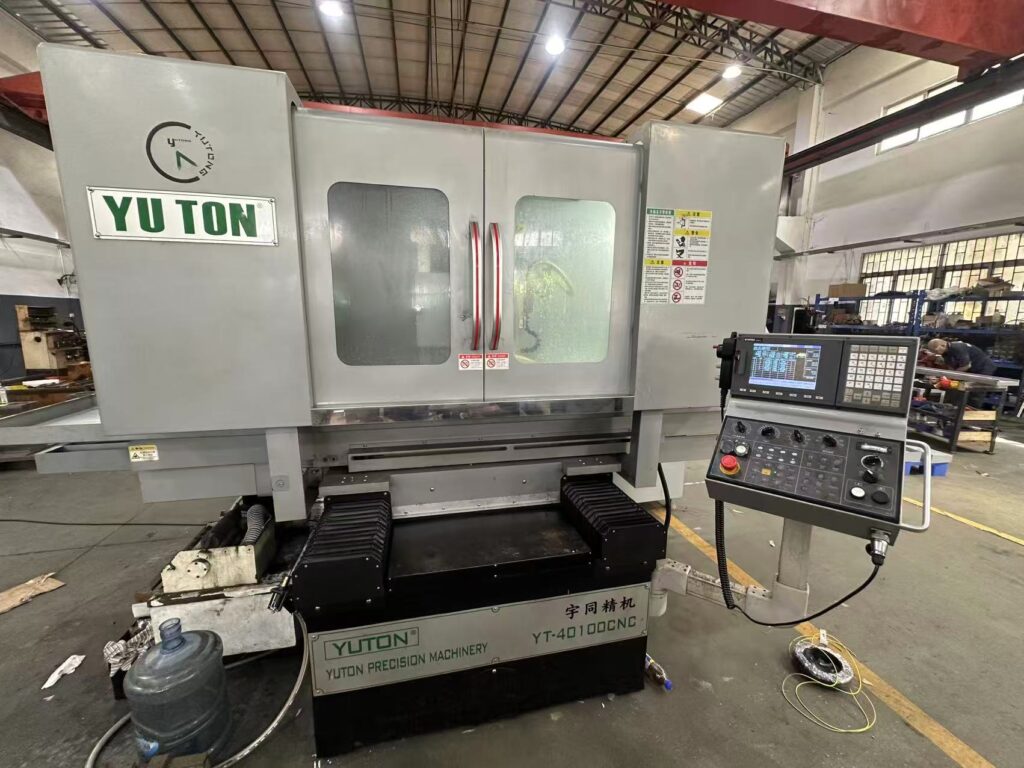
YUTON surface grinders are built with the precision and component quality that digital twin applications demand. Furthermore, with 150 employees across a 15,000 m² facility with 7 production buildings in Dongguan, YUTON produces 3,100 grinders annually — ranking among China’s top three manufacturers. Moreover, every machine is constructed on Meehanite cast iron for vibration damping, equipped with Japanese, Taiwanese, and American core components, and certified to ISO 9001 and CE standards.
Therefore, the structural rigidity and spindle accuracy of YUTON grinders provide the stable baseline that digital twin models require for reliable predictions. In addition, spindle runout below 0.002 mm and minimum feed of 0.001 mm mean that the virtual model can trust the physical machine to execute commands precisely. Whether you operate a https://surfacegrindermfg.com/cnc-surface-grinder/ for automated production or a https://surfacegrindermfg.com/automatic-surface-grinder/ for high-volume runs, the machine quality provides the foundation for effective digital twin implementation.
Furthermore, YUTON’s https://surfacegrindermfg.com/hydraulic-surface-grinder/ models offer the heavy-cut capability that benefits most from digital-twin-driven optimization, where balancing removal rate against thermal limits requires real-time simulation. For toolroom precision work, the https://surfacegrindermfg.com/manual-surface-grinder/ delivers the manual control flexibility that digital twins augment with setup validation and parameter suggestions. Explore the full range at https://surfacegrindermfg.com/ — and consider how digital twin capability enhances the value of every grinder in your shop.
The International Organization for Standardization provides standards for machine tool data interfaces at https://www.iso.org/, and the European Commission’s Industry 5.0 framework promotes human-centric digital manufacturing at https://ec.europa.eu/. Moreover, the Association for Manufacturing Technology offers resources on smart machining implementation at https://www.amtonline.org/, and the Society of Manufacturing Engineers covers digital twin case studies at https://www.sme.org/. Modern Machine Shop documents real-world digital twin deployments at https://www.mmsonline.com/.
FAQ
Q1: What is the difference between simulation and a digital twin?
Simulation runs a model offline with fixed inputs. However, a digital twin is continuously synchronized with the real machine through live sensor data, updating its state in real time. Therefore, the twin can predict current and future behavior, not just hypothetical scenarios.
Q2: Do I need a CNC grinder to use digital twin technology?
Yes, effectively. Furthermore, digital twins require sensor data, axis position feedback, and CNC program information to function. Therefore, CNC surface grinders are the natural platform. Manual grinders lack the sensor infrastructure and programmable axes that digital twins need.
Q3: How much does digital twin implementation cost?
Costs vary by scope. Furthermore, a single-machine pilot with basic sensors and a cloud platform typically starts at USD 15,000–30,000 for hardware and software in the first year. However, enterprise-scale deployments across multiple machines can reach USD 100,000–200,000. Moreover, ROI is typically achieved within 12–18 months through reduced scrap, shorter setup times, and lower unplanned downtime.
Q4: Can a digital twin prevent chatter in grinding?
Yes, partially. Furthermore, by modeling the machine’s structural dynamics and the grinding contact stiffness, the twin can identify spindle speed and depth-of-cut combinations that fall within chatter-prone regions. Therefore, operators avoid these parameters before running the job. However, real-time chatter suppression during grinding still requires active adaptive control systems.
Q5: Is digital twin technology only for large manufacturers?
No. Furthermore, cloud-based platforms and vendor-provided solutions have made digital twins accessible to small and mid-size shops. Therefore, even a single CNC surface grinder can benefit from virtual commissioning and predictive maintenance. Moreover, starting with one machine and expanding gradually is the recommended approach for smaller operations.
Conclusion
A digital twin grinding machine transforms how shops plan, validate, and optimize grinding operations. Therefore, from virtual commissioning that prevents crashes to predictive maintenance that reduces downtime by 30–40%, the technology delivers measurable value across the production lifecycle. Moreover, as GrindingHub 2026 demonstrated, digital twins are no longer experimental — they are being deployed as integral components of connected grinding systems. Consequently, shops that invest in digital twin capability today gain a competitive edge in setup efficiency, process reliability, and equipment uptime. Furthermore, the technology scales from a single CNC grinder to entire grinding cells, making it relevant for shops of every size.