
Adaptive grinding control is transforming surface grinding from a static, operator-dependent process into a self-correcting system. Therefore, manufacturers who adopt it achieve tighter tolerances, lower scrap rates, and more consistent quality — without sacrificing cycle time.
What Is Adaptive Grinding Control?
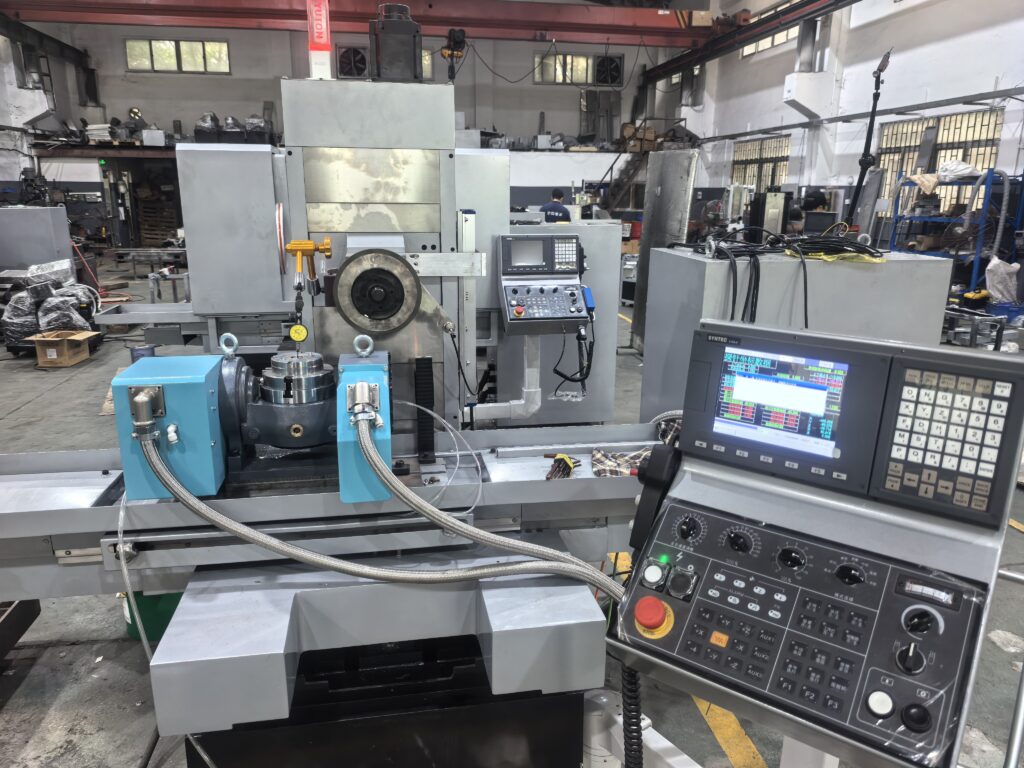
Adaptive grinding control refers to a closed-loop system that monitors grinding conditions in real time and automatically adjusts machine parameters to maintain optimal performance. Moreover, unlike conventional grinding on a standard https://surfacegrindermfg.com/manual-surface-grinder/ — where wheel speed, feed rate, and depth of cut remain fixed throughout the cycle — adaptive control continuously reads sensor signals and modifies these variables on the fly.
The concept is not entirely new. Furthermore, early forms of adaptive force control appeared on cylindrical grinders in the 1990s. However, what makes 2026 different is the convergence of affordable multi-sensor arrays, edge computing, and AI-driven algorithms that can react within milliseconds. Consequently, today’s adaptive grinding control systems are practical, affordable, and proven on production floors worldwide.
Three Layers of an Adaptive System
A complete adaptive grinding control architecture consists of three functional layers:
- Sensing layer — Force sensors, acoustic emission (AE) transducers, power monitors, and thermal probes capture process signals at 100 Hz to 10 kHz sampling rates.
- Decision layer — Edge processors or CNC-integrated algorithms analyze the data, detect anomalies (wheel dulling, thermal buildup, chatter onset), and calculate corrective actions.
- Actuation layer — The CNC controller adjusts spindle speed, feed rate, infeed depth, or coolant flow in real time, typically within one interpolation cycle (1–2 ms on modern CNCs).
Therefore, the system forms a continuous sense-decide-act loop that keeps the grinding process within its optimal window at all times.
Five Core Technologies Behind Adaptive Grinding Control
Understanding the technology stack helps you evaluate systems and plan upgrades. Moreover, each technology addresses a specific failure mode in grinding operations.
1. Grinding Force Monitoring
Grinding force is the most direct indicator of process health. Furthermore, tangential force reflects cutting efficiency, while normal force indicates contact pressure and wheel sharpness. When a wheel dulls, normal force rises sharply while material removal rate stays constant — a classic sign that dressing is overdue.
In practice, force sensors — typically piezoelectric or strain-gauge types — mount between the workpiece and the magnetic chuck or within the spindle housing. Therefore, they capture force changes in real time without interfering with the grinding zone.
2. Acoustic Emission Sensing
Acoustic emission sensors detect high-frequency stress waves (100 kHz–1 MHz) generated by grain fracture, wheel loading, and micro-cracking. In addition, AE signals are uniquely sensitive to thermal events: grinding burn produces a distinct frequency shift that force sensors alone may miss.
Combining AE with power monitoring has been shown to reduce thermal scrap by over 80% in documented aerospace grinding applications, while also extending wheel life by 30–50%. Furthermore, the Society of Manufacturing Engineers highlights adaptive process monitoring as a key enabler for achieving Industry 4.0 goals in precision machining (https://www.sme.org/).
3. Spindle Power and Current Analysis
Spindle power draw is the simplest and most cost-effective sensor to retrofit. Moreover, it requires no mechanical modification — only a current transformer on the spindle drive. A 20% power spike above baseline reliably indicates wheel dulling, excessive infeed, or material hardness variation.
However, power alone lacks the resolution to detect early-stage thermal damage. Consequently, best-practice systems combine power monitoring with AE or force sensing for comprehensive coverage.
4. Thermal Monitoring
Temperature at the grinding zone is the critical variable for preventing burn and residual stress. Furthermore, embedded thermocouples in coolant nozzles and infrared pyrometers aimed at the wheel-workpiece contact are the two most common approaches. In 2026, miniaturized fiber-optic temperature sensors now achieve measurement densities of up to 10 points per square centimeter on critical machine components, enabling precise thermal deformation mapping (https://www.mmsonline.com/).
5. Adaptive Algorithm and Closed-Loop Control
The algorithm is the brain of adaptive grinding control. Furthermore, modern implementations range from simple threshold-based logic (reduce feed when force exceeds X) to AI-driven predictive models that learn from historical data.
At GrindingHub 2026 in Stuttgart, the shift from isolated machines to connected, adaptive process chains was the dominant theme. As a result, vendors demonstrated closed-loop systems where sensor data flows directly into CNC interpolation cycles, enabling sub-millisecond corrections. The Association for Manufacturing Technology notes that this convergence of sensing and actuation marks the transition from “grinding by recipe” to “grinding by feedback” (https://www.amtonline.org/).
Key Benefits for Your Grinding Process
The benefits of adaptive grinding control go beyond scrap reduction. Moreover, they touch every aspect of grinding economics and quality.
Scrap Reduction and Quality Consistency
By detecting thermal buildup, wheel loading, or chatter in their earliest stages, adaptive control prevents defects before they occur. Therefore, shops report scrap reductions of 60–82% after implementing closed-loop grinding, depending on the baseline defect rate and material difficulty.
Wheel Life Extension
When the system triggers dressing only when the wheel actually needs it — not on a fixed timer — wheel consumption drops significantly. Furthermore, adaptive dressing strategies based on real-time wear monitoring have extended wheel life by 30–50% in documented cases (https://www.mmsonline.com/).
Cycle Time Optimization
Conventional grinding uses conservative parameters to avoid defects, leaving performance on the table. However, adaptive grinding control runs at aggressive parameters while the process is stable, then automatically backs off when conditions change. Consequently, overall cycle times decrease by 5–15% without sacrificing quality.
Operator Skill Dependency Reduction
In traditional grinding, experienced operators “read” the spark pattern, listen to the sound, and adjust by feel. Moreover, this expertise takes years to develop and is increasingly scarce. Adaptive control codifies this judgment into algorithms, making consistent quality less dependent on individual skill.
Real-World Applications in 2026
Adaptive grinding control is now deployed across multiple industries. Therefore, the following examples illustrate the breadth of practical impact.
Aerospace: HSS and Superalloy Broach Grinding
Aerospace grinding demands near-zero thermal damage tolerance. Furthermore, adaptive systems combining power, AE, and temperature sensors have documented scrap reductions from 10% to below 2% on M42 HSS broaches, with wheel life increasing by 35%. In addition, the same framework applies to Inconel 718 turbine blade roots, where even minor burn is unacceptable.
Automotive: Closed-Loop Batch Consistency
In high-volume automotive tool production, in-process measurement systems feed dimensional data back into the grinding cycle on machines like YUTON’s https://surfacegrindermfg.com/automatic-surface-grinder/. Therefore, batches stay within tolerance even as wheels wear and thermal conditions drift — reducing manual intervention and end-of-batch scrap.
Precision Optics: Sub-Micron Form Error Correction
Recent research demonstrates cup-wheel concentric grinding for spherical optics where adaptive error compensation reduced form error PV from 57.7 μm to 0.3 μm in a single correction cycle. Moreover, this level of correction is only possible with real-time measurement feedback and trajectory recalculation.
Implementation: Getting Started with Adaptive Grinding Control
Adopting adaptive grinding control does not require a full machine replacement. However, a phased approach reduces risk and builds internal capability progressively.
Phase 1: Add Power Monitoring (Lowest Cost, Highest Impact)
Install a spindle current sensor and logging software. Furthermore, this costs under $500 for most machines and provides immediate visibility into wheel sharpness, overload events, and cycle-to-cycle variation. Review the data for 2–4 weeks before investing further.
Phase 2: Integrate AE or Force Sensing
Add an AE sensor or force dynamometer to capture signals that power monitoring misses — particularly early-stage thermal damage and chatter onset. In addition, connect the sensor output to your CNC’s analog input or an external edge processor.
Phase 3: Enable Closed-Loop Control
Program the CNC to adjust feed rate, infeed, or dressing frequency based on sensor thresholds. Moreover, start with conservative rules (e.g., reduce feed by 10% when normal force exceeds 120% of baseline) before progressing to AI-based predictive models.
Key Integration Considerations
- Sensor bandwidth must exceed the process dynamics you want to control. For chatter detection, sampling at 10 kHz or higher is recommended.
- Latency from sensor to actuator must be shorter than the event you are trying to prevent. Thermal buildup develops over seconds (tolerant of 100 ms loops), but chatter oscillates at 500–2000 Hz (requiring sub-millisecond response).
- Machine rigidity matters. Adaptive control compensates for process variation, but it cannot fix a machine that lacks structural stiffness. Therefore, start with a well-maintained, rigid grinder like YUTON’s Meehanite-cast surface grinders for best results (https://surfacegrindermfg.com/hydraulic-surface-grinder/).
Why YUTON Machines Support Adaptive Integration
YUTON surface grinders provide the mechanical foundation that adaptive grinding control requires. Furthermore, our machines are built with several advantages that make sensor integration and closed-loop control effective:
- Meehanite cast iron construction across all seven factory buildings ensures vibration damping and thermal stability — critical baselines for any adaptive system to work against.
- Japanese, Taiwanese, and American core components (spindle bearings, ball screws, servo motors) deliver the positioning accuracy and repeatability that closed-loop corrections depend on.
- ISO 9001 + CE certification means every machine leaves our 15,000 m² Dongguan facility with documented quality and traceability — the same discipline adaptive control automates (https://www.iso.org/). Furthermore, CE compliance ensures our machines meet European safety and electromagnetic compatibility standards required for sensor-equipped grinding systems (https://ec.europa.eu/).
- 3,100 units sold in 2025, ranking YUTON among China’s top three surface grinder manufacturers. Therefore, our installed base provides extensive field data for adaptive algorithm validation. Learn more at https://surfacegrindermfg.com/.
- CNC, PLC hybrid, and manual models are available, so you can choose the control architecture that matches your adaptive integration strategy. Explore our https://surfacegrindermfg.com/cnc-surface-grinder/ for CNC models, https://surfacegrindermfg.com/automatic-surface-grinder/ for automatic grinding solutions, or https://surfacegrindermfg.com/manual-surface-grinder/ for manual platforms.
FAQ: Adaptive Grinding Control
What is adaptive grinding control?
Adaptive grinding control is a closed-loop system that monitors grinding conditions — such as force, vibration, temperature, and acoustic emission — in real time and automatically adjusts machine parameters (feed rate, infeed, wheel speed) to maintain optimal cutting performance and prevent defects.
How is adaptive grinding control different from CNC programming?
CNC programming defines a fixed toolpath and parameter sequence before the grind begins. However, the adaptive system modifies those parameters during the cycle based on live sensor feedback. Therefore, it adds a real-time decision layer on top of the programmed path.
What sensors does an adaptive grinding system use?
Typical sensors include spindle power monitors, piezoelectric force dynamometers, acoustic emission transducers, thermocouples, and — in advanced systems — machine vision or in-process gauges. Moreover, most production deployments use two or more sensor types for redundancy and broader coverage.
Can I retrofit adaptive grinding control to an existing machine?
Yes. Furthermore, power monitoring and AE sensors can be added to most surface grinders without mechanical modification. However, closed-loop parameter adjustment requires CNC or PLC control — manual machines can log data but cannot act on it automatically.
What results can I expect from adaptive grinding control?
Documented production results include 60–82% scrap reduction, 30–50% wheel life extension, and 5–15% cycle time improvement. In addition, the consistency benefits — reduced operator dependency and improved traceability — often exceed the direct cost savings.
Conclusion
Adaptive grinding control represents the next evolution in surface grinding precision and efficiency. Therefore, manufacturers who embrace closed-loop sensor feedback and automatic parameter adjustment gain a decisive edge in quality, cost, and consistency. The technology is proven, the sensors are affordable, and the algorithms are mature enough for production deployment in 2026.
Whether you are grinding hardened tool steels, aerospace alloys, or precision optics, adaptive grinding control ensures your machine operates at its optimal point — not at a conservative compromise. Furthermore, YUTON’s rigid, precision-built surface grinders provide the ideal mechanical platform for adaptive integration.
Ready to explore a grinder that supports adaptive control? Visit https://surfacegrindermfg.com/ to learn more about our CNC, automatic, hydraulic, and manual surface grinders — all built on Meehanite cast iron with Japanese, Taiwanese, and American core components, ISO 9001 + CE certified, and backed by a manufacturer ranked among China’s top three.