
Surface grinding and lapping both produce flat, precise surfaces — but they work differently and serve different purposes. Grinding removes material with a bonded abrasive wheel at high speed. However, lapping removes material with loose abrasive slurry between a lap and the workpiece at low speed. Therefore, choosing the right process saves time, reduces cost and delivers the surface quality your part requires.
How Surface Grinding Works
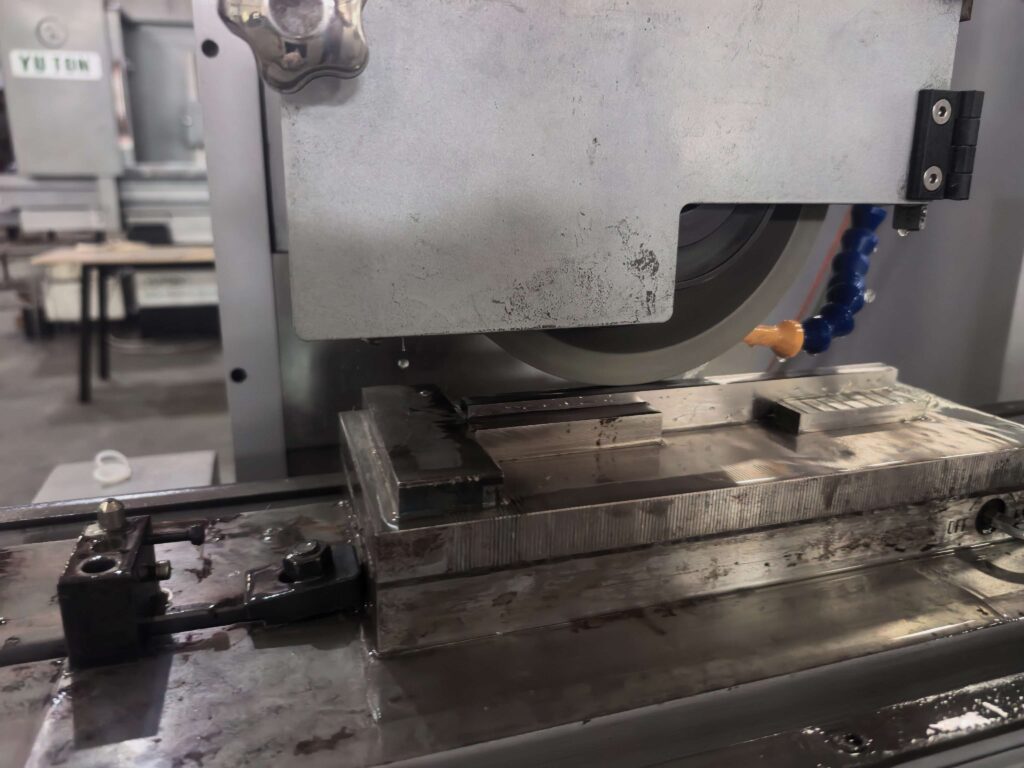
Surface grinding uses a rotating grinding wheel — a bonded composite of abrasive grains and bonding material — to remove thin layers from a workpiece surface. Moreover, the wheel spins at 30-35 m/s peripheral speed while the workpiece reciprocates under it on a machine table.
Key characteristics of surface grinding:
- Material removal rate: 0.01-0.05mm per pass
- Achievable flatness: 0.002-0.005mm over 300mm
- Achievable surface roughness: Ra 0.1-0.8 μm
- Process type: fixed-abrasive, deterministic and repeatable
- Setup time: 5-15 minutes with magnetic chuck for ferrous parts
Therefore, surface grinding is a machining process where the wheel form transfers to the workpiece, making it deterministic. Once the machine is set and the wheel dressed, every part in the batch receives the same surface geometry within machine accuracy limits. Explore surface grinder options at https://surfacegrindermfg.com/.
How Lapping Works
Lapping uses a soft metal or composite lap — typically cast iron, copper or ceramic — charged with loose abrasive particles in a carrier fluid. Furthermore, a lapping machine moves the workpiece in a figure-eight or random orbital pattern while applying light downward pressure.
Key characteristics of lapping:
- Material removal rate: 0.001-0.01mm per cycle — much slower than grinding
- Achievable flatness: 0.0002-0.001mm over 100mm — better than grinding
- Achievable surface roughness: Ra 0.01-0.1 μm — better than grinding
- Process type: loose-abrasive, non-deterministic
- Setup time: 15-30 minutes for charging and conditioning
However, lapping cannot correct severe geometric errors — it only refines what grinding or milling already established.
Surface Grinding vs Lapping: Direct Comparison
| Factor | Surface Grinding | Lapping |
|---|---|---|
| Material removal rate | High (0.01-0.05mm/pass) | Low (0.001-0.01mm/cycle) |
| Best flatness | 0.002-0.005mm/300mm | 0.0002-0.001mm/100mm |
| Best surface finish | Ra 0.1-0.8 μm | Ra 0.01-0.1 μm |
| Abrasive type | Bonded wheel (fixed grains) | Loose slurry (free grains) |
| Process control | Deterministic, repeatable | Semi-random, requires monitoring |
| Typical cycle time | 2-10 minutes per part | 10-60 minutes per part |
| Surface texture | Directional (grinding lay) | Non-directional (matte) |
| Part size range | Up to 600mm+ | Typically under 300mm |
Therefore, the comparison reveals a clear division: grinding removes material and establishes geometry. However, lapping refines geometry and improves finish. Consequently, they are complementary, not competing processes.
When to Choose Surface Grinding
Surface grinding is the right choice when your part needs:
- Significant material removal. If you need to remove more than 0.05mm, grinding is the only practical choice. Lapping at that rate would take hours per part.
- Re-establishing flatness after heat treatment. Hardened parts warp during quenching. Therefore, surface grinding restores flat references efficiently — typically 5-10 minutes per side. The https://surfacegrindermfg.com/hydraulic-surface-grinder/ delivers stable grinding force for this work.
- Batch production with consistent results. Surface grinding is deterministic. Set the machine, dress the wheel, and every part comes out the same. Moreover, automatic surface grinders from https://surfacegrindermfg.com/automatic-surface-grinder/ excel at batch consistency.
- Large parts. Surface grinders handle parts from small gauge blocks to large machine beds over 600mm long. However, lapping machines are typically limited to smaller parts.
When to Choose Lapping
Lapping is the right choice when your part needs:
- Extreme flatness. Optical flats, gauge blocks and reference standards require flatness within one light band (0.0003mm) that surface grinding cannot achieve.
- Very fine surface finish. Surfaces below Ra 0.1 μm — such as optical windows and high-pressure seal faces — need lapping. Grinding can reach Ra 0.08-0.1 μm but carries directional marks.
- Non-directional surface texture. Some applications fail with a directional lay because it creates leakage paths. Furthermore, lapping produces a uniform texture without directional bias.
- Minimal subsurface damage. Lapping with loose abrasive at low pressure removes material with minimal subsurface stress. Therefore, for optical components and semiconductor wafers, lapping is required after grinding.
The Grinding-Lapping Sequence
For parts that need lapping-level quality but have too much material to remove by lapping alone, the standard approach is grind first, then lap.
Step 1: Surface Grind to Establish Flatness
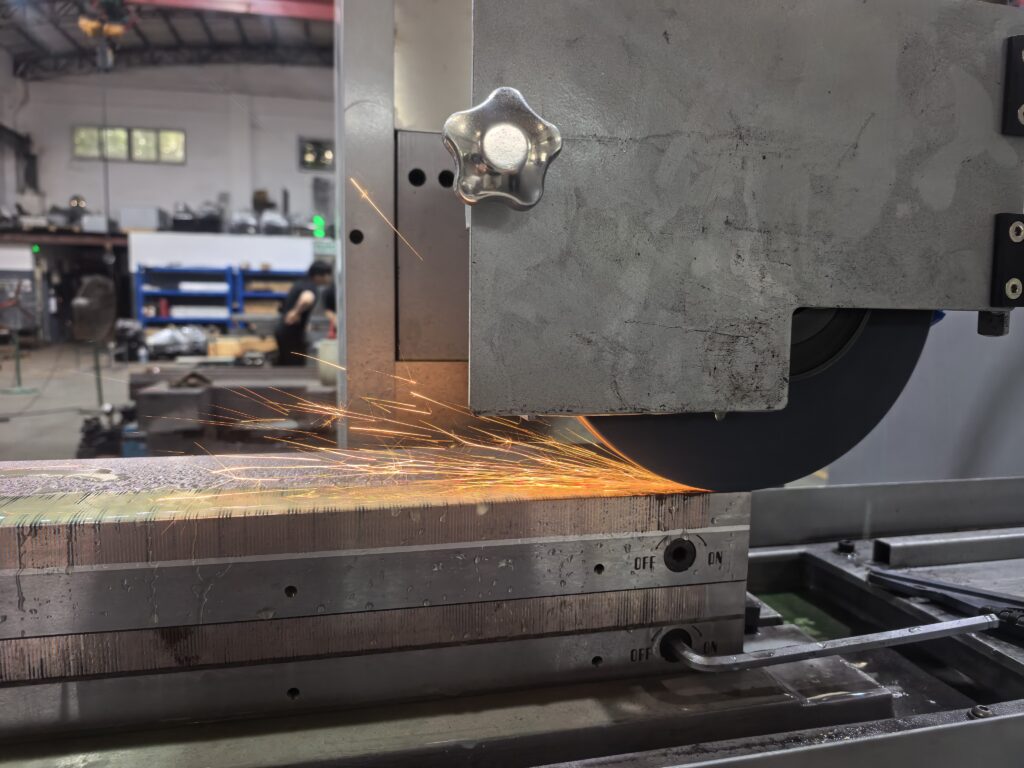
Grind the part to within 0.01-0.02mm of final dimension, leaving a grinding allowance for lapping. Moreover, the ground surface provides the geometric foundation that lapping will refine. A CNC surface grinder like the https://surfacegrindermfg.com/cnc-surface-grinder/ can grind complex flat geometries that need lapping.
Step 2: Clean Thoroughly
Remove all grinding coolant, chips and debris. Any contamination transferred to the lap causes scratching and degrades lap flatness.
Step 3: Lap to Final Dimension
Use a progressively finer abrasive sequence — start with 15μm, then 5μm, then 1μm for final finish. Therefore, each step removes the damage layer from the previous step while improving flatness and finish.
Step 4: Inspect
After lapping, clean the part and measure flatness with an optical flat and monochromatic light. Surface roughness can be measured with a profilometer.
Cost Comparison: Grinding vs Lapping
Understanding the cost structure helps justify the process choice.
- Surface grinding costs approximately $2-5 per part for a 100mm × 100mm steel part in production, with cycle time of 3-8 minutes.
- Lapping costs approximately $5-15 per part for the same part, with cycle time of 15-40 minutes.
- Combined grind plus lap costs approximately $7-18 per part.
Therefore, the lesson is clear: lapping alone for parts needing significant removal is expensive. However, grinding first, then lapping, is almost always more cost-effective. The Society of Manufacturing Engineers covers grinding-lapping process chains — see https://www.sme.org/.
Common Mistakes in Process Selection
- Lapping when grinding suffices. If your part needs flatness of 0.005mm and finish of Ra 0.2 μm, surface grinding delivers this directly. Lapping adds cost without benefit.
- Grinding when lapping is required. Specifying Ra 0.05 μm pushes grinding beyond its practical capability. Therefore, lapping achieves this level reliably and economically.
- Skipping the grinding step before lapping. Starting lapping from a milled surface wastes time. Always grind before lapping unless the surface is already within 0.01mm of specification.
- Over-lapping. Extended lapping beyond the target wastes time and degrades lap condition. Monitor flatness with optical flats and stop when achieved.
Industries That Use Both Processes
- Gauge and metrology. Gauge blocks and surface plates are ground to rough dimension, then lapped to final flatness within 0.00005mm.
- Optical. Lenses, mirrors and windows are ground to shape, then lapped and polished. The Optical Society covers precision optical fabrication — see https://www.osa.org/.
- Seal manufacturing. Mechanical seal faces require flatness within 0.001mm and finish below Ra 0.05 μm. Grinding brings the face to dimension; lapping achieves the flatness and finish.
- Semiconductor. Silicon wafers are ground to thickness, then lapped and polished to final flatness for photolithography resolution.
YUTON Surface Grinders: The First Step Before Lapping
When your process chain requires grinding before lapping, YUTON surface grinders provide the reliable first step. Moreover, our machines produce the flat, consistent surfaces that lapping needs as a starting point.
Built with Meehanite cast iron construction and spindle bearings from leading Japanese, Taiwanese and American suppliers, YUTON grinders deliver the rigidity and precision that established grinding demands. Furthermore, with 150 employees, 15,000 square meters across 7 buildings in Dongguan, and 3,100 machines produced in 2025, YUTON ranks among China’s top three by volume.
ISO 9001 and CE certifications ensure every machine meets quality standards before shipment. Therefore, our range includes manual, hydraulic, automatic and CNC models for every grinding requirement. Visit https://surfacegrindermfg.com/ to explore the full product line. The American Society of Mechanical Engineers publishes standards for both processes — see https://www.asme.org/. Modern Machine Shop covers applications — see https://www.mmsonline.com/.
FAQ: Surface Grinding vs Lapping
Can lapping replace surface grinding?
No. Lapping removes material too slowly for significant stock removal. If you need to remove more than 0.05mm, surface grinding is required first.
What flatness can surface grinding achieve?
Precision surface grinding achieves 0.002-0.005mm flatness over 300mm. Lapping can improve this to 0.0002-0.001mm, but only on smaller areas.
Do I always need lapping after grinding?
No. Most industrial applications — die faces, machine ways, seal plates — are fully served by surface grinding alone. However, lapping is only needed when flatness or finish exceeds grinding capability.
Why is lapping slower than grinding?
Lapping uses loose abrasive at low pressure and speed. Each abrasive particle removes a tiny amount of material randomly. Therefore, the process is inherently slower than the controlled, high-speed cutting of a bonded grinding wheel.
What is the typical grinding allowance before lapping?
Allow 0.01-0.02mm total for lapping after the final grinding pass. This gives lapping enough material to remove the grinding damage layer while reaching final dimension and finish.
Conclusion
Surface grinding removes material fast and establishes geometry. However, lapping refines geometry and improves finish to levels grinding cannot reach. Therefore, for most precision parts, the answer is not grinding or lapping — it is grinding then lapping. Moreover, grind to near-final dimension, then lap to final flatness and finish. Consequently, this sequence is faster and more cost-effective than either process alone. For the surface grinding step, explore YUTON’s precision surface grinders at https://surfacegrindermfg.com/.