
Artificial intelligence is moving from research labs to the shop floor, and precision grinding is one of the manufacturing sectors where AI delivers the most tangible impact. From adaptive process control to predictive quality assurance, AI in precision grinding helps shops produce tighter-tolerance parts with less waste, less downtime, and fewer manual interventions. This guide covers the current state of AI in grinding, real applications in production today, and what the technology means for machine shops investing in their future.
What Does AI Mean for Precision Grinding?
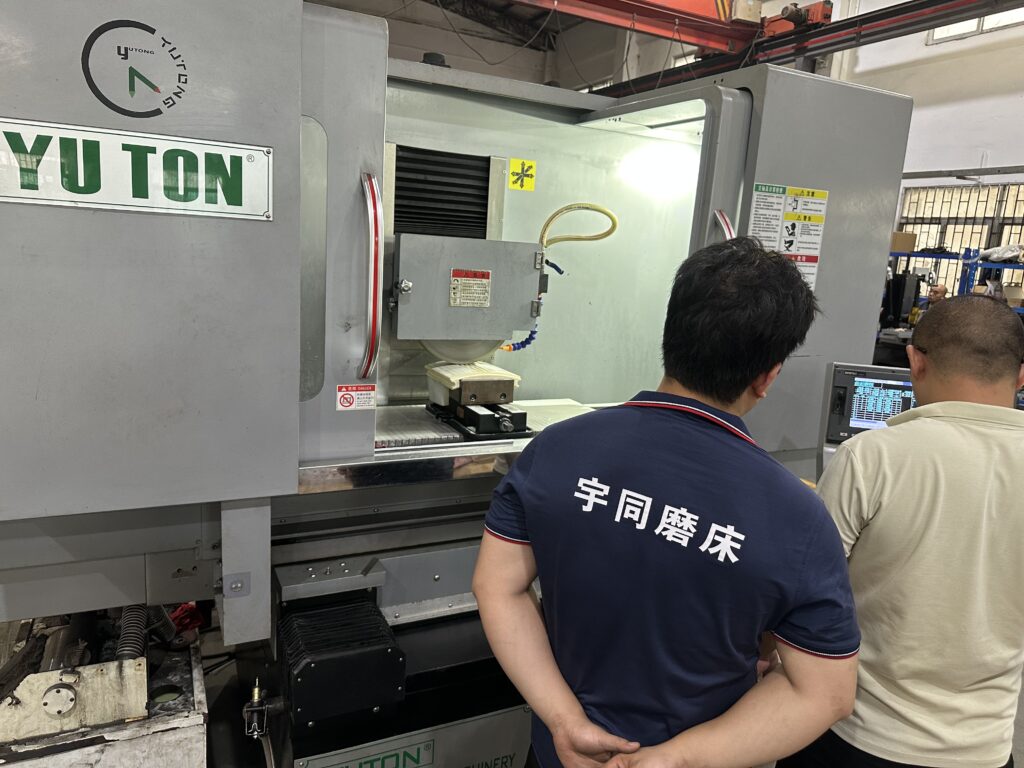
In the context of surface grinding, artificial intelligence refers to software systems that learn from process data to make autonomous or semi-autonomous decisions. Unlike conventional CNC programs that follow fixed instructions, AI-driven systems analyze real-time sensor data, historical performance records, and part quality outcomes to optimize grinding parameters dynamically.
AI does not replace the grinding machine or the operator. Instead, it adds a layer of intelligence that augments human expertise and machine capability. The result is faster setup, more consistent quality, and lower operating costs.
According to ISO’s manufacturing technology standards (https://www.iso.org/), AI-enhanced manufacturing systems are classified as Level 3–4 smart factory capabilities, representing the transition from connected monitoring to autonomous optimization.
5 Real Applications of AI in Precision Grinding
1. Adaptive Feed Rate Control
Traditional grinding uses fixed feed rates programmed by the operator or process engineer. AI systems adjust feed rates in real time based on cutting force, spindle load, and vibration data. When the wheel is fresh and cutting freely, the system increases feed to maximize material removal. As the wheel wears and cutting forces rise, the system reduces feed to maintain surface quality and prevent burn.
This adaptive approach typically improves cycle time by 10–20% while maintaining or improving surface finish consistency. For shops running CNC surface grinders (https://surfacegrindermfg.com/cnc-surface-grinder/) on high-volume production, these savings compound quickly.
2. Predictive Wheel Dressing
Determining the optimal moment to dress a grinding wheel has traditionally relied on operator experience or fixed interval schedules. AI systems analyze vibration signatures, power consumption patterns, and surface finish measurements to predict exactly when dressing is needed.
Rather than dressing too early (wasting wheel life) or too late (producing defective parts), AI schedules dressing at the precise point where quality begins to decline. According to manufacturing engineering research (https://www.sme.org/), AI-optimized dressing extends wheel life by 15–25% while maintaining consistent surface quality throughout each dress cycle.
3. Intelligent Part Program Generation
Writing and optimizing grinding part programs is time-consuming, especially for complex geometries or unfamiliar materials. AI-powered CAM systems can generate optimized grinding paths automatically, considering wheel geometry, material properties, and tolerance requirements.
Some advanced systems learn from previous jobs, applying proven parameter combinations to new parts with similar characteristics. This reduces programming time from hours to minutes and eliminates the trial-and-error scrap that typically accompanies new part setup.
4. Predictive Quality Assurance
AI models trained on historical grinding data can predict part quality before the part is even measured. By analyzing process signals—spindle current, vibration, coolant temperature, and cycle time—the system estimates whether the finished part will meet tolerance specifications.
When the model predicts an out-of-tolerance condition, it can trigger an automatic regrind pass, alert the operator, or adjust parameters for the next part. According to precision manufacturing insights (https://www.mmsonline.com/), AI-based quality prediction reduces scrap by 20–35% and cuts inspection time by allowing focused measurement on flagged parts rather than 100% inspection.
5. Energy Optimization
Grinding machines consume significant energy, especially during heavy roughing passes. AI systems optimize the balance between material removal rate and energy consumption, identifying parameter combinations that deliver the required output with minimum power draw.
For facilities running multiple grinding machines, AI-driven energy management can reduce total grinding energy costs by 10–15% without affecting throughput or quality.
How AI Integrates with Modern Grinding Equipment
Sensor Infrastructure
AI requires data, and data comes from sensors. Modern CNC grinders equipped with spindle vibration sensors, power meters, force sensors, and temperature probes generate the continuous data streams that AI algorithms need. If your existing machines lack these sensors, retrofit kits are available for many models.
YUTON’s CNC surface grinders (https://surfacegrindermfg.com/cnc-surface-grinder/) are built with open communication interfaces (OPC-UA, MTConnect) that feed sensor data directly to edge computing units or cloud platforms where AI analytics run.
Edge Computing vs. Cloud Processing
AI inference can happen at the edge (on the machine controller or a local server) or in the cloud. Edge computing delivers sub-millisecond response times for adaptive control and real-time parameter adjustments. Cloud processing handles heavier analytics workloads like historical trend analysis, digital twin simulation, and fleet-wide benchmarking.
Most production deployments use a hybrid approach: edge AI handles real-time control, while cloud AI manages longer-term optimization and reporting.
Integration with MES and ERP
AI-generated insights become more valuable when connected to broader factory systems. Feeding grinding quality data into your MES allows production schedules to account for real machine capability. Linking predictive maintenance alerts to your ERP system automatically generates work orders and orders spare parts before failures occur.
The Business Case for AI in Precision Grinding
表格
| Metric | Typical Improvement |
|---|---|
| Cycle time | 10–20% reduction |
| Wheel life | 15–25% extension |
| Scrap rate | 20–35% reduction |
| Energy cost | 10–15% reduction |
| Programming time | 50–70% reduction |
| Unplanned downtime | 30–40% reduction |
These improvements are not theoretical. According to the European Commission’s advanced manufacturing programs (https://ec.europa.eu/), European manufacturers deploying AI in precision machining report combined productivity gains of 15–25% within the first 18 months of implementation.
The payback period for AI-enhanced grinding systems typically ranges from 12 to 24 months, depending on production volume and current process maturity.
Getting Started: 3 Practical Steps
Step 1: Start with Data Collection
You cannot apply AI without data. Begin by instrumenting your most critical grinding machines with vibration, power, and temperature sensors. Connect them to a monitoring platform and collect at least 3–6 months of baseline data. This data becomes the training foundation for AI algorithms.
Step 2: Identify High-Impact Use Cases
Not every grinding operation benefits equally from AI. Focus initial deployment on:
- High-volume repetitive jobs where small cycle time improvements yield large savings
- Expensive materials where scrap reduction directly impacts profitability
- Critical-tolerance parts where quality consistency is essential
For these applications, upgrading to AI-ready automatic surface grinders (https://surfacegrindermfg.com/automatic-surface-grinder/) with built-in sensor infrastructure and open connectivity provides the fastest path to implementation.
Step 3: Partner with Technology Providers
Few machine shops have in-house AI expertise. Partner with technology providers who specialize in manufacturing AI applications. Look for vendors with proven deployments in grinding (not just general manufacturing), references from similar-sized shops, and responsive technical support.
According to industry technology association AMT (https://www.amtonline.org/), shops that work with specialized AI partners achieve production-ready deployments 3–4 times faster than those attempting to build solutions internally.
Common Misconceptions About AI in Grinding
“AI Will Replace Operators”
AI automates data analysis and parameter optimization, but it does not eliminate the need for skilled operators. Operators still set up machines, load parts, interpret alerts, and make judgment calls that AI cannot handle. The most effective deployments augment operator expertise rather than replace it.
“AI Only Works for High-Volume Production”
While high-volume operations see the fastest ROI, even job shops running small batches benefit from AI-driven programming assistance, predictive maintenance, and quality prediction. The key is matching the AI application to the production environment.
“AI Is Too Expensive for Small Shops”
Cloud-based AI platforms with subscription pricing have made the technology accessible to shops of all sizes. Many providers offer entry-level packages starting with basic monitoring and analytics, allowing shops to scale their AI investment as they demonstrate returns.
The Future of AI in Precision Grinding
Looking beyond 2026, several developments will further expand AI’s role in grinding:
- Generative AI for process planning: Systems that automatically propose complete grinding strategies based on part geometry and material specifications
- Federated learning: AI models that learn across multiple shops without sharing proprietary data, improving prediction accuracy for all participants
- Autonomous grinding cells: Self-optimizing production cells that manage wheel selection, dressing, part loading, and quality verification with minimal human intervention
Shops that build AI-ready infrastructure today—sensor-equipped machines, data pipelines, and analytical capabilities—will be positioned to adopt these advances as they mature.
For manufacturers planning their next equipment investment, YUTON surface grinders (https://surfacegrindermfg.com/) combine precision build quality with modern digital interfaces designed for AI integration. With Japanese, Taiwanese, and American core components, hydraulic surface grinders (https://surfacegrindermfg.com/hydraulic-surface-grinder/) and CNC models from YUTON deliver the mechanical foundation that AI systems need to perform at their best.
Final Thoughts
AI in precision grinding has moved beyond experimentation into production-ready deployment. Adaptive control, predictive dressing, intelligent programming, and quality assurance are delivering measurable improvements in cycle time, quality, and cost across shops of all sizes.
The technology is accessible, the ROI is proven, and the competitive landscape rewards early adopters. Whether you start with sensor retrofits on existing machines or invest in new AI-ready grinding equipment, the important step is to begin collecting data and building the foundation for smarter grinding operations.