
A surface grinder for marine components must deliver precision flatness on parts that face relentless saltwater corrosion, extreme loads, and strict classification society standards. Therefore, shipbuilders and marine repair facilities need grinding solutions engineered for the unique demands of ocean-going equipment.
Why Marine Components Demand Specialized Surface Grinding
Marine propulsion and steering systems operate in some of the harshest environments on earth. Furthermore, saltwater attacks metals continuously, and even minor surface imperfections accelerate corrosion, vibration, and fatigue failure. Consequently, precision surface finishing is not a luxury — it is a survival requirement for components that cannot fail at sea.
Consider the chain reaction: a rough journal surface on a stern shaft tears the elastomeric lip seal. Therefore, seawater enters the bearing housing, lubricating oil leaks into the ocean, and the vessel faces environmental fines plus unplanned dry-docking. Moreover, a single unscheduled dry-dock event can cost hundreds of thousands of dollars in lost charter revenue and emergency repairs.
Key Surface Finish Requirements for Marine Parts
Different functional zones on marine components demand specific surface roughness values. Moreover, these Ra targets are not arbitrary — they directly affect component survival:
- Sliding fit surfaces (bearing journals): Ra 0.8–1.6 μm. This micro-texture traps and maintains lubrication films.
- Interference fit surfaces (taper connections): Ra 0.4–0.8 μm. A smoother finish prevents galling during hydraulic assembly.
- Seal running areas (stern tube journals): Ra below 0.4 μm. Ultra-smooth surfaces prevent premature lip seal wear.
Therefore, selecting the right surface grinder for marine components means achieving and verifying these finishes consistently on large, heavy workpieces.
Critical Marine Components That Require Surface Grinding
Understanding which parts need precision grinding helps you specify the right machine capacity and features. Furthermore, each component category presents distinct challenges.
Propeller Shaft Journals and Tapers for Marine Components
Propeller shafts present extreme length-to-diameter ratios that challenge any grinding setup. Moreover, the taper fit between the shaft and propeller hub is a critical failure point — typically 1:10 or 1:12 taper ratios verified by blue-fitting to achieve 70–80% contact area. Therefore, the surface grinder must hold concentricity within 0.02 mm across long spans.
Shaft journals that ride in bearings require consistent Ra values. In addition, any ovality or taper deviation causes localized bearing loading, which accelerates wear and triggers destructive vibration modes through the entire driveline.
Rudder Stock and Bearing Surfaces
Rudder stocks endure massive bending moments and shock loads from heavy seas. Furthermore, the bearing surfaces must achieve H7/f7 clearance fits with Ra 0.8–1.6 μm. Therefore, grinding these surfaces flat and dimensionally accurate directly affects steering stability and rudder bearing life.
A surface grinder capable of handling these long, heavy forgings needs robust workholding and sufficient table travel. Moreover, Meehanite cast iron construction in the grinder itself provides the vibration damping essential for consistent finish on such large parts (https://surfacegrindermfg.com/hydraulic-surface-grinder/).
Engine Mount Pads and Alignment Surfaces for Marine Components
Marine engine alignment depends on precision-ground mounting pads. Furthermore, misalignment between the engine and the propulsion shaft causes vibration, premature coupling wear, and crankshaft stress. Therefore, these pads must be flat within 0.02 mm per meter — a tolerance easily achieved with a properly maintained surface grinder for marine components.
Heat Exchanger and Flange Sealing Surfaces
Seawater heat exchangers, manifold flanges, and pressure vessel end caps all require flat, scratch-free sealing surfaces. Moreover, in saltwater service, even a microscopic scratch on a flange face becomes an initiation point for crevice corrosion. Therefore, a surface grinder for marine components must deliver Ra 0.8 μm or better on these sealing faces, followed by proper passivation, as standard practice in marine fabrication.
Material Challenges in Marine Surface Grinding
Marine components use some of the most difficult-to-machine alloys. Therefore, your surface grinder for marine components must account for material-specific behavior.
Duplex Stainless Steels (2205, 2507)
Duplex stainless steels offer exceptional saltwater corrosion resistance and high yield strength. However, they work-harden rapidly during grinding, requiring consistent feed rates and sharp abrasives. Furthermore, duplex grades demand CBN wheels with controlled cutting forces to prevent surface hardening that ruins dimensional accuracy (https://surfacegrindermfg.com/cnc-surface-grinder/).
Nickel-Aluminum Bronzes
Propeller hubs, rudder bearings, and seawater pump housings often use nickel-aluminum bronze (C95800). Moreover, this alloy machines relatively easily but tends to load grinding wheels. Therefore, friable aluminum oxide wheels with open structures and generous coolant flow prevent wheel glazing and maintain consistent Ra values.
Carbon Steels with Protective Cladding
Large commercial vessel shafts use forged carbon steel (ASTM A668) with bronze or Inconel cladding on bearing journals. Furthermore, grinding must transition smoothly between the base metal and the cladding without stepping or waviness. Therefore, the grinder must offer precise infeed control — typically 0.005 mm increments — to blend these dissimilar-material zones.
Titanium Alloys
Naval vessels and high-speed craft increasingly use titanium for weight savings and corrosion immunity. However, titanium generates high grinding temperatures and reacts chemically with standard abrasives. Consequently, vitrified CBN wheels with high-pressure coolant delivery are essential to prevent thermal damage and maintain surface integrity.
Machine Selection Criteria: Choosing a Surface Grinder for Marine Components
Choosing a surface grinder for marine components involves evaluating capacity, precision, and environmental resilience. Moreover, marine workshops often operate in coastal locations with high humidity and salt-laden air.
Work Envelope and Load Capacity
Propeller shafts, rudder stocks, and engine bed plates are large and heavy. Therefore, the grinder must offer:
- Table size: Minimum 1000 × 300 mm for medium marine parts; 2000 × 600 mm for shaft journals and bed plates
- Maximum workpiece weight: 500–2000 kg depending on component scale
- Longitudinal travel: Sufficient for full-length grinding passes without repositioning
Precision and Repeatability
Marine tolerances may appear generous compared to aerospace standards, but the consequences of deviation are equally severe. Furthermore, a journal that is 0.03 mm out of round will destroy a stern tube seal within months. Therefore, the grinder must deliver:
- Flatness: ≤ 0.01 mm per 300 mm
- Surface finish: Consistent Ra 0.4–1.6 μm depending on functional zone
- Repeatability: ± 0.005 mm for batch operations
A CNC surface grinder with programmable infeed and automatic spark-out ensures these tolerances are met without relying on operator skill. Moreover, PLC hybrid controls offer a cost-effective middle ground — manual operation for one-off repairs, programmed cycles for repetitive marine part families (https://surfacegrindermfg.com/automatic-surface-grinder/). The European Machinery Directive also sets safety requirements that precision grinding equipment must comply with (https://ec.europa.eu/).
Coolant and Corrosion Protection
In a marine workshop, the grinder itself must resist corrosion. Therefore, look for machines with sealed way covers, stainless steel coolant plumbing, and corrosion-resistant paint systems. Furthermore, the coolant system should deliver high flow rates (50+ L/min) at adequate pressure to flush swarf and control heat — critical when grinding work-hardening alloys.
Pre- and Post-Coating Grinding Considerations
Many marine components receive protective claddings or ceramic coatings after initial machining. Moreover, the grinding process must account for dimensional changes introduced by these coatings.
Therefore, machinists intentionally undersize certain shaft diameters based on engineering drawings, leaving precise room for the final protective layer. Furthermore, post-coating grinding restores the component to its nominal operational dimensions while maintaining the coating integrity. This requires a surface grinder for marine components with fine infeed resolution — 0.001 mm — and a rigid spindle that will not chatter on the hard coating surface.
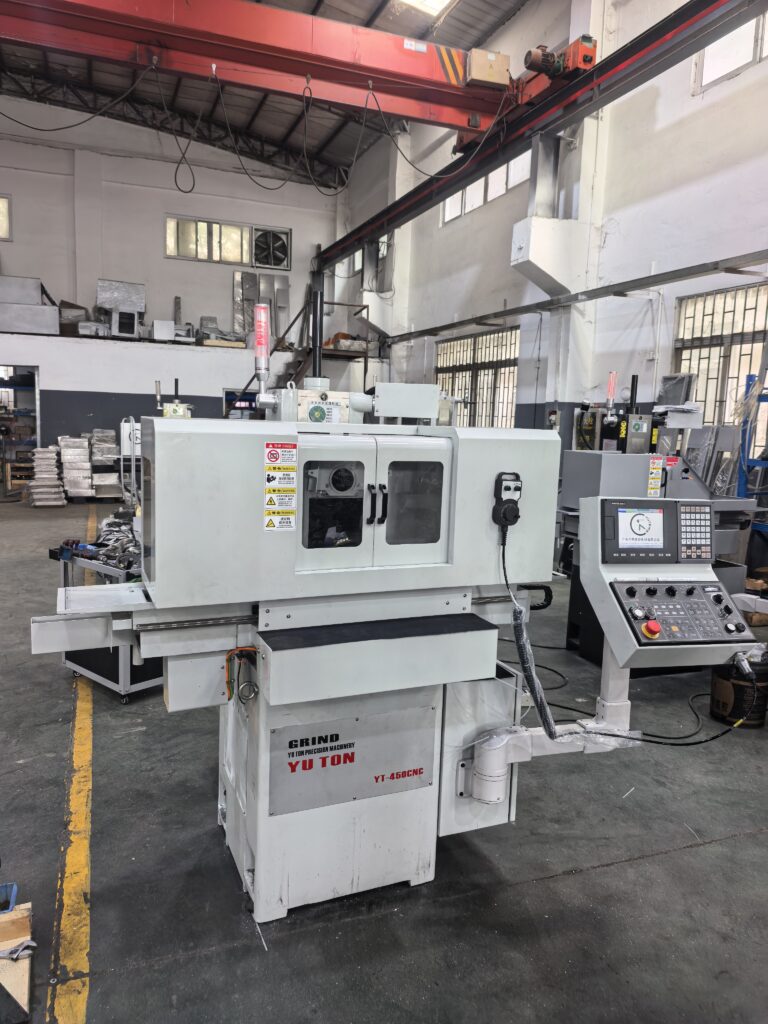
YUTON Surface Grinders for Marine Component Precision
YUTON builds surface grinders that meet the rigorous demands of marine component manufacturing and repair. Furthermore, our machines are engineered for the precision, capacity, and durability that shipyards and marine workshops require:
- Meehanite cast iron construction provides superior vibration damping and long-term thermal stability — essential for holding flatness on large marine parts over extended grinding cycles.
- Japanese, Taiwanese, and American core components deliver the spindle accuracy, feed resolution, and reliability that marine classification societies demand.
- ISO 9001 + CE certification ensures every machine from our 15,000 m² Dongguan facility meets documented quality standards — the traceability discipline that marine work requires (https://www.iso.org/). Industry standards for marine machining processes are also documented by SME (https://www.mmsonline.com/).
- 3,100 units sold in 2025, ranking YUTON among China’s top three surface grinder manufacturers. Moreover, this scale means consistent quality and the engineering depth to customize machines for marine-specific work envelopes.
- CNC, PLC hybrid, and manual models let you match control sophistication to your marine part mix — from manual toolroom repair work to CNC-programmed production runs on shaft journals and seal surfaces (https://surfacegrindermfg.com/manual-surface-grinder/).
Explore YUTON surface grinders at https://surfacegrindermfg.com/ — built for precision, proven in the harshest environments, backed by 150 people and 7 production buildings in Dongguan. For CNC-specific grinding capabilities, visit https://surfacegrindermfg.com/cnc-surface-grinder/.
FAQ: Surface Grinder for Marine Components
What surface finish do marine shaft journals need?
Marine shaft journal surfaces typically require Ra 0.8–1.6 μm for sliding fit bearing surfaces. Furthermore, seal running areas demand Ra below 0.4 μm to prevent premature lip seal wear and seawater ingress.
Can a standard surface grinder handle marine parts?
A standard surface grinder can handle smaller marine components like engine mount pads and flange faces. However, large propeller shafts and rudder stocks require machines with extended table travel, high load capacity, and robust workholding. Therefore, verify the work envelope before committing.
What grinding wheel works best for duplex stainless steel?
CBN wheels in resin or vitrified bonds work best for duplex stainless steels. Moreover, the wheel must maintain consistent cutting forces to prevent work-hardening, which causes dimensional drift and surface burn. Therefore, avoid aluminum oxide wheels on duplex grades.
How does saltwater corrosion affect grinding strategy?
Saltwater corrosion demands smoother surface finishes because rough surfaces trap chloride ions and initiate pitting. Furthermore, post-grinding passivation is essential for stainless steel marine parts. Therefore, include passivation in your process plan, and grind to Ra 0.8 μm or better on all exposed surfaces.
What certifications should a marine component grinder have?
The surface grinder for marine components should carry ISO 9001 and CE certification at minimum. Moreover, marine components require EN 10204 3.1 material certificates and traceability documentation that classification society surveyors (ABS, DNV, Lloyd’s) will verify. Therefore, your grinding process must be fully documented and auditable (https://www.sme.org/).
Conclusion
A surface grinder for marine components must deliver more than flatness — it must produce finishes that resist saltwater corrosion, maintain seal integrity, and meet classification society standards under the most unforgiving service conditions. Therefore, machine selection demands careful evaluation of work envelope, precision capability, material compatibility, and environmental resilience.
From propeller shaft tapers to rudder bearing surfaces, from engine alignment pads to heat exchanger flanges, every ground surface on a marine component directly affects vessel safety and operational cost. Moreover, YUTON surface grinders — with Meehanite cast iron construction, Japanese/Taiwanese/American core components, and ISO 9001 + CE certification — provide the precision foundation that marine workshops need.
Discover the full YUTON range at https://surfacegrindermfg.com/ — CNC, automatic, hydraulic, and manual models built for the demands of saltwater service, backed by 3,100 units delivered in 2025 (https://www.amtonline.org/).