
Choosing the right ceramic grinding wheel selection determines surface finish, wheel life, and grinding efficiency. Therefore, this guide explains the five critical factors — abrasive type, grit size, grade, structure, and bond — so you can match the wheel to your workpiece and machine with confidence.
What Makes Ceramic Bond Wheels Different
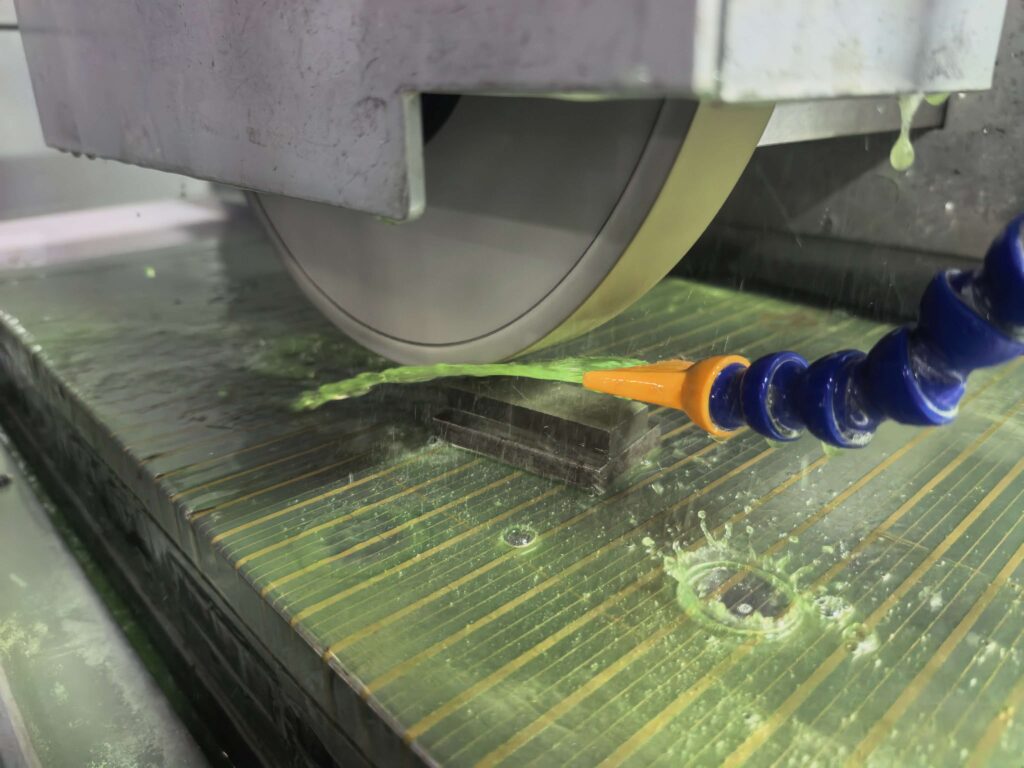
A ceramic (vitrified) bond wheel uses glass-like materials that fuse abrasive grains at high temperatures above 1200°C. Consequently, the resulting bond is rigid, porous, and chemically stable. The pores between grains carry coolant into the grinding zone and allow chips to escape, reducing loading and heat buildup. Moreover, ceramic bond wheels maintain their shape exceptionally well during grinding, which makes them the standard choice for precision surface grinding where dimensional accuracy matters. In addition, they respond predictably to dressing, producing consistent sharp cutting edges across the wheel face.
However, ceramic bond wheels are more brittle than resin or rubber bonds. Therefore, they are not recommended for rough snagging, heavy offhand grinding, or impact-prone applications. Furthermore, most surface grinding operations use vitrified wheels because the rigidity and porosity combination delivers the best balance of form accuracy, finish quality, and dressing stability. Proper ceramic grinding wheel selection begins with understanding these bond characteristics.
Five Core Factors for Ceramic Grinding Wheel Selection
Selecting the right wheel requires evaluating five specification parameters. Each factor influences grinding performance, and getting any one wrong leads to poor finish, rapid wheel wear, or workpiece burn.
Abrasive Grain Type
The abrasive mineral determines what materials the wheel can cut effectively. Furthermore, the wrong abrasive causes rapid grain breakdown or chemical reaction with the workpiece.
- Brown Aluminum Oxide (A): Tough and economical, ideal for mild steel and general-purpose surface grinding. Most shop-floor wheels use this as the default.
- White Aluminum Oxide (WA): Friable grains that fracture to expose fresh cutting edges, reducing heat generation. Therefore, WA excels on hardened tool steel (HRC 50–65) where thermal damage is a concern.
- Pink Aluminum Oxide (PA): Slightly tougher than WA with good self-sharpening behavior. Moreover, PA works well on high-speed steel and alloy steels requiring medium finish.
- Silicon Carbide (C/GC): Harder and sharper than aluminum oxide but more brittle. Consequently, C is preferred for cast iron, non-ferrous metals (aluminum, brass, copper), and ceramic materials. However, silicon carbide reacts with iron at high grinding temperatures, so avoid it on steel.
- Ceramic Alumina (SG): Microcrystalline grain that fractures at the sub-micron level, maintaining sharpness throughout its life. Furthermore, SG wheels grind 30–50% faster than conventional aluminum oxide with lower grinding forces, making them the premium choice for difficult-to-grind alloys.
Grit Size Selection
Grit size controls the trade-off between material removal rate and surface finish. Lower numbers mean coarser grains that remove stock faster but leave a rougher surface. Conversely, higher grit numbers produce finer finishes at slower removal rates.
| Grit Range | Classification | Typical Application |
|---|---|---|
| 24–36 | Coarse | Roughing, heavy stock removal on mild steel |
| 46–60 | Medium | General surface grinding, most common for production |
| 60–80 | Medium-fine | Semi-finish grinding, tool steel work |
| 80–120 | Fine | Finish grinding, achieving Ra 0.4–0.8 μm |
| 120–220 | Very fine | Super-finishing, lapping-grade surfaces |
Moreover, most surface grinding operations use 46–60 grit as the primary wheel and 80–120 grit for finishing passes. In addition, selecting grit one step finer than minimum requirement provides a safety margin for finish quality without sacrificing too much removal rate.
Grade and Structure
Grade indicates how strongly the bond holds abrasive grains — not the hardness of the grains themselves. Therefore, the selection rule is counterintuitive: use soft-grade wheels (I–J) on hard workpieces, and hard-grade wheels (L–M) on soft workpieces.
When grinding hardened steel, grains dull quickly. A soft bond releases these dull grains before they rub and generate excessive heat, exposing sharp new grains — this is the self-dressing mechanism. However, on soft mild steel, grains stay sharp longer, so a harder bond holds them in place for efficient cutting. Furthermore, if the grade is too soft, the wheel wears too fast and loses form. Conversely, if the grade is too hard, the wheel glazes and causes burn marks.
Structure (porosity) indicates spacing between abrasive grains. Open structure (8–12) provides more pore volume for chip clearance and coolant flow. Therefore, open-structure wheels suit heavy stock removal and soft materials. However, dense structure (4–6) packs more grains per unit area for finer finishes. Moreover, for precision surface grinding of hardened steel, medium structure (6–8) is typically the best starting point.
Matching Wheel to Workpiece Material
Proper ceramic grinding wheel selection depends on the workpiece material. Therefore, use the following recommendations as starting points.
Mild and Carbon Steel
Specification: A 46–60 K–L 5–8 V. Brown aluminum oxide in medium grit with medium-hard grade handles most mild steel grinding. Moreover, an A60KV wheel is the standard starting choice for general workshop grinding. This specification pairs well with both https://surfacegrindermfg.com/hydraulic-surface-grinder/ and manual machines.
Hardened Tool Steel (HRC 50–65)
Specification: WA 60–80 I–J 6–8 V. White aluminum oxide provides the friability needed to avoid burn on hardened surfaces. Therefore, a softer grade (I–J) allows self-dressing. Furthermore, using two wheels — WA60IV for roughing and WA80JV for finishing — covers most toolroom requirements. When grinding D2 or M2 steel for die components, a WA60IV wheel on a https://surfacegrindermfg.com/manual-surface-grinder/ delivers excellent results.
Stainless Steel
Specification: WA 46–60 I–K 7–9 V. Stainless steel work-hardens under grinding, generating heat. Therefore, a friable abrasive and open structure help prevent glazing and loading. Moreover, adequate coolant at 15–25 L/min is essential to avoid thermal discoloration on 304 and 316 grades. For CNC grinding of stainless components, the https://surfacegrindermfg.com/cnc-surface-grinder/ with a WA46IV wheel provides consistent results.
Cast Iron
Specification: C 36–46 K–M 5–7 V. Silicon carbide cuts cast iron efficiently because the brittle grain fractures the graphite flakes and hard carbides in the iron matrix. However, avoid aluminum oxide on cast iron — it loads and glazes. Furthermore, medium-hard grade (K–M) works well because cast iron is relatively soft and does not dull grains quickly.
Non-Ferrous Metals
Specification: C 36–46 I–J 8–10 V. Soft, ductile materials like aluminum and brass load wheels easily. Therefore, silicon carbide in open structure with soft grade prevents loading. Moreover, copious coolant and frequent dressing are essential to maintain cutting efficiency.
Ceramic vs Resin vs Rubber Bond
Understanding ceramic grinding wheel selection also means knowing when ceramic bond is the right choice versus alternatives. Therefore, compare the three bond types:
- Ceramic (Vitrified): Rigid, porous, easy to dress, excellent form holding. Best for precision surface grinding, cylindrical grinding, and any application requiring tight tolerances. Moreover, ceramic wheels can be trued to within 0.002 mm runout, making them indispensable for high-precision work.
- Resin (Resinoid): More flexible, runs cooler, shock resistant. Best for rough grinding, cutting-off, and high-speed operations above 50 m/s. However, resin wheels deflect more under load and lose form faster than ceramic.
- Rubber: Most elastic, produces very fine finishes, used for regulating wheels in centerless grinding and polishing. Furthermore, rubber wheels are limited to lower speeds and lighter cuts.
Therefore, for surface grinding on precision machine tools, ceramic bond is almost always the correct choice. In addition, the International Organization for Standardization provides grinding wheel safety and specification standards at https://www.iso.org/
Practical Tips for Better Wheel Performance
Even with proper ceramic grinding wheel selection, operational practice determines the actual results. Therefore, follow these guidelines:
- Balance the wheel before mounting. An unbalanced wheel causes vibration, chatter marks, and poor finish. Moreover, static balancing followed by dynamic balancing at operating speed ensures smooth grinding. This step is critical on any https://surfacegrindermfg.com/automatic-surface-grinder/ running production parts.
- Dress regularly and correctly. A dull wheel produces heat, burns workpieces, and degrades finish. Furthermore, dress with a single-point diamond dresser using 0.01–0.03 mm depth and 1–3 passes at operating speed.
- Use adequate coolant. Ceramic bond wheels benefit from flood coolant at 15–30 L/min. Therefore, soluble oil at 5–8% concentration provides lubrication and cooling for most steel grinding. However, dry grinding on hardened steel will cause thermal damage and surface cracks.
- Match wheel speed to specification. Every wheel has a maximum operating speed marked on the blotter. Moreover, exceeding this speed risks wheel fracture and serious injury. The European Commission safety directives for grinding machines are documented at https://ec.europa.eu/
- Select wheel diameter for the job. Larger wheels (300–350 mm) provide more cutting grains per revolution and cooler grinding. However, smaller wheels (200–250 mm) fit compact machines and suffice for light cuts. The Association for Manufacturing Technology provides machinery safety resources at https://www.amtonline.org/
Why YUTON Machines Support Precision Ceramic Wheel Grinding
YUTON surface grinders are designed to maximize the performance of ceramic bond grinding wheels. Furthermore, with 150 employees across a 15,000 m² facility with 7 production buildings in Dongguan, YUTON produces 3,100 grinders annually — ranking among China’s top three manufacturers. Moreover, every machine is built on Meehanite cast iron for vibration damping, equipped with Japanese, Taiwanese, and American core components, and certified to ISO 9001 and CE standards.
Therefore, whether you need a https://surfacegrindermfg.com/automatic-surface-grinder/ for production runs, a https://surfacegrindermfg.com/hydraulic-surface-grinder/ for heavy cuts, or a https://surfacegrindermfg.com/ for versatile toolroom work, YUTON machines deliver the spindle accuracy and structural rigidity that ceramic grinding wheel selection demands. In addition, spindle runout below 0.002 mm and minimum feed of 0.001 mm ensure your chosen wheel specification produces the finish and tolerance your parts require. The Society of Manufacturing Engineers offers additional grinding process resources at https://www.sme.org/
For buyers evaluating a https://surfacegrindermfg.com/cnc-surface-grinder/ for precision work, YUTON’s production scale and quality system provide the assurance that each grinder supports demanding grinding operations consistently. Moreover, Modern Machine Shop covers advanced grinding techniques and wheel management at https://www.mmsonline.com/
FAQ
Q1: What does the marking “WA 60 K 8 V” mean on a ceramic wheel?
WA = white aluminum oxide abrasive, 60 = medium grit size, K = medium-hard grade, 8 = medium-open structure, V = vitrified (ceramic) bond. Therefore, this wheel suits general surface grinding of hardened tool steel.
Q2: Can I use a ceramic wheel on aluminum?
Not recommended. Aluminum loads ceramic bond wheels quickly because the soft chips fill the pores. Therefore, use silicon carbide in open structure with rubber or resin bond instead, or use a dedicated non-loading ceramic wheel with pore inducers.
Q3: How often should I dress a ceramic grinding wheel?
Dress when the wheel surface appears shiny (glazed) or when finish quality drops. Moreover, for precision surface grinding, dressing every 10–20 workpieces is common. However, heavy roughing may require dressing more frequently.
Q4: What is the difference between ceramic and vitrified bond?
There is no difference — both terms describe the same glass-like bond formed by high-temperature firing above 1200°C. Furthermore, “vitrified” is standard in ISO specifications, while “ceramic” is common in American and Asian markets.
Q5: Why does my ceramic wheel keep glazing on hardened steel?
The grade is too hard for the workpiece material. Therefore, switch to a softer grade (I or J) so the bond releases dull grains through self-dressing. Furthermore, check that your coolant flow is adequate — insufficient cooling accelerates glazing.
Conclusion
Getting ceramic grinding wheel selection right is the foundation of productive surface grinding. Therefore, match abrasive type to workpiece material, select grit for the required finish, choose grade opposite to workpiece hardness, and specify structure based on chip clearance needs. Moreover, ceramic bond wheels offer the rigidity, porosity, and dressability that precision surface grinding demands — making them the default choice on properly equipped machines. Consequently, when your grinding results fall short, the wheel specification is often the first variable to review before adjusting machine parameters. Explore the full range of precision surface grinders at https://surfacegrindermfg.com/ and find the right machine for your grinding application.