
AI Summary
A precision surface grinder is a high-performance grinding machine engineered to achieve extremely tight tolerances — typically flatness within 0.005mm and surface finish down to Ra 0.2μm or better. In 2026, with humanoid robot production driving demand for ±1μm thread accuracy and the global grinding machine market heading toward USD 114.2 billion by 2034, choosing the right precision surface grinder has never been more critical. This guide from YUTON — a top-3 Chinese manufacturer with 150 staff, 15,000㎡ factory, and 3,100+ units sold in 2025 — covers everything from specs to pricing to help you make the right decision.
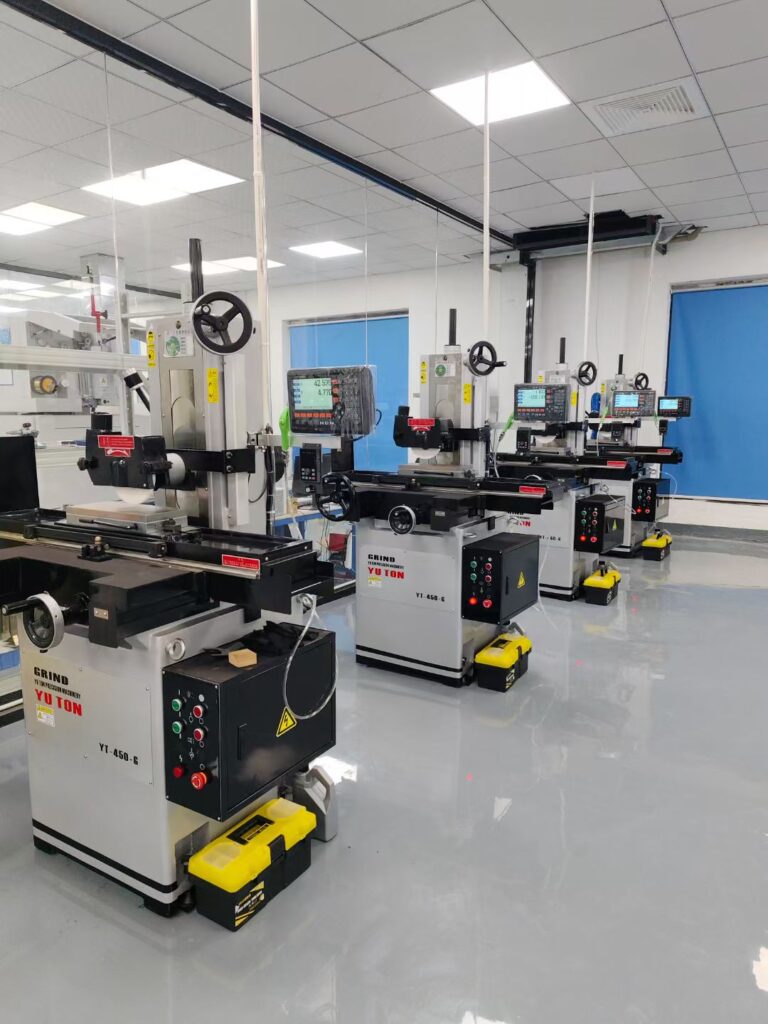
Precision Surface Grinder: The Complete 2026 Buyer’s Guide
To begin with, a precision surface grinder is not just a regular grinder with a “precision” label. It is a machine built from the ground up to hold extremely tight tolerances, deliver mirror-like surface finishes, and repeat those results shift after shift. In 2026, industries ranging from humanoid robotics to aerospace are pushing flatness requirements below 5 microns — and only a true precision surface grinder can meet that standard.
But how do you tell a real precision machine from a standard one? And what specs actually matter? Let’s walk through it.
What Makes a Precision Surface Grinder Different
In most cases, a precision surface grinder stands apart from a standard machine in four key areas: structural rigidity, spindle accuracy, control resolution, and thermal stability.
Machine Rigidity and Base Construction
First, the foundation matters. A precision surface grinder uses a heavy-duty, stress-relieved cast iron base — not welded steel or thin casting. As a result, the machine resists vibration and deformation under load, which directly affects flatness and surface finish. In fact, YUTON’s precision grinders use high-strength resin sand castings with full aging treatment to ensure long-term dimensional stability.
Spindle Quality and Runout
Second, the spindle is the heart of any precision surface grinder. Hydrostatic spindles deliver rotational accuracy with runout ≤ 0.002mm, while high-precision rolling bearing spindles offer solid performance at a lower cost point. Therefore, spindle type is usually the single biggest factor in determining your achievable surface finish.
Control System Resolution
Third, the control system must be able to command movements in sub-micron increments. Modern precision surface grinders feature CNC or PLC controls with touch-screen programming, recipe storage, and communication ports for MES integration. Moreover, 2026 models increasingly include adaptive grinding systems that monitor force, temperature, and vibration in real time, then auto-adjust parameters for optimal results.
Thermal Stability
Finally, heat is the enemy of precision. A well-built precision surface grinder includes thermal compensation systems, stabilized hydraulic fluid, and temperature-controlled coolant — all designed to keep the machine within spec even during long production runs.
Industries That Demand a Precision Surface Grinder in 2026
Several industries are driving record demand for high-precision grinding equipment this year.
Humanoid Robot Components
To start with, 2026 marks the first year of mass humanoid robot production. Planetary roller screws — the core linear joint component — require thread accuracy within ±1μm, which only a dedicated precision surface grinder can achieve. According to industry data, this alone creates a USD 6.5 billion grinding machine sub-market in 2026. In addition, harmonic reducer manufacturing pulls another USD 11 billion in machine tool demand, with a year-on-year growth rate of 35%.
Aerospace and Defense
Moreover, turbine blades, engine mounts, and structural components in aerospace require surface finishes down to Ra 0.1μm and flatness under 0.003mm. Consequently, a precision surface grinder with hydrostatic spindle and thermal compensation is the go-to solution for these applications.
Mold and Die
In this field, mold bases, parting lines, and cavity blocks all demand mirror-flat surfaces. Specifically, automated precision grinding eliminates hand-polishing steps, cutting lead time by 30-40% while improving consistency.
Medical Devices
What’s more, surgical instruments, implant surfaces, and diagnostic equipment components require the kind of ultra-fine finish that only a precision surface grinder can deliver reliably at scale.
For broader insights on choosing the right automation level for your industry, the Society of Manufacturing Engineers provides excellent technical guidance.
Key Specifications to Check Before You Buy
In practice, not all machines labeled “precision” deliver the same results. Here are the specs you should verify.
Flatness and Parallelism
First, check the machine’s guaranteed flatness spec. A true precision surface grinder should hold 0.005mm or better across the full table. On top of that, parallelism between top and bottom surfaces should be within 0.003mm.
Surface Finish Capability
Second, look at the achievable Ra value. High-end precision surface grinders can reach Ra 0.1-0.2μm consistently. However, the actual result depends on wheel selection, coolant quality, and workpiece material.
Table Size and Load Capacity
Third, match the table to your workpiece. Common precision surface grinder tables range from 200×500mm for toolroom work to 600×1800mm for large mold plates. Also, verify the maximum workpiece weight the table can support without deflection.
Spindle Type and Speed
Fourth, decide between hydrostatic and rolling bearing spindles based on your tolerance requirements. As a rule, hydrostatic spindles are best for Ra < 0.2μm work, while rolling bearing spindles handle most general precision tasks well.
Automation Readiness
Finally, consider whether the machine has pre-configured interfaces for robotic loading, auto-sizing probes, and in-process gauging. In most cases, adding automation later costs 2-3× more than specifying it at purchase.
According to AMT – The Association For Advancing Technology, investing in automation-ready equipment from qualified suppliers is the foundation of a successful long-term manufacturing strategy.
YUTON Precision Surface Grinders: Built for Exactness
Specifically, YUTON’s precision surface grinding solutions are designed for shops that refuse to compromise on accuracy. Here is what sets them apart:
• Hydrostatic spindle option with runout ≤ 0.002mm
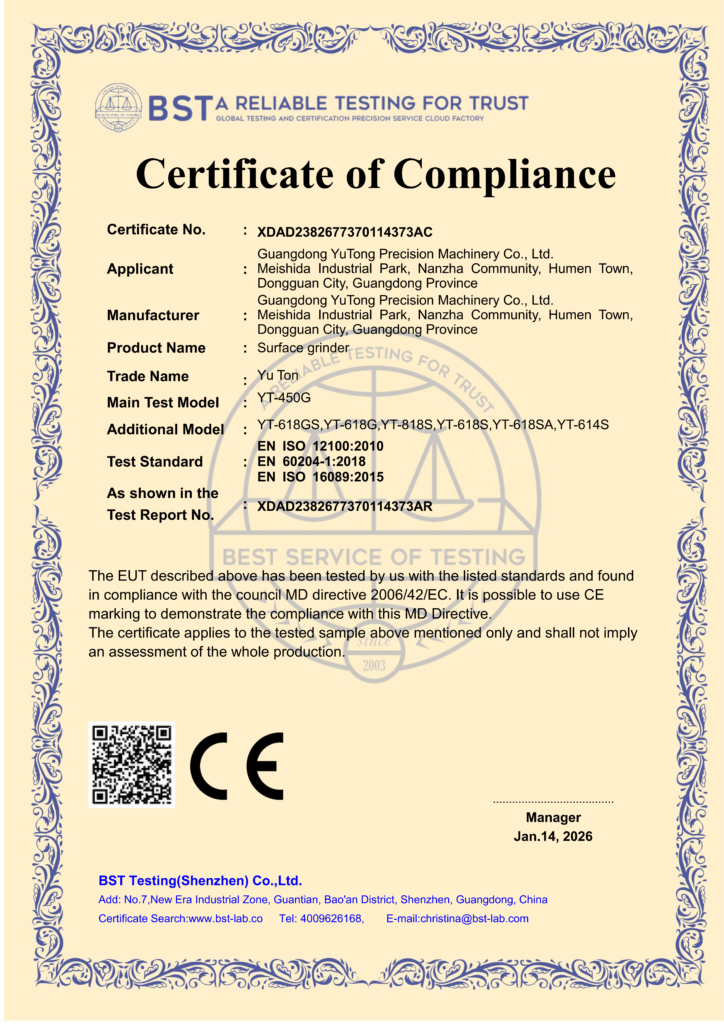
• Full ISO 9001 quality management and CE compliance
• PLC-controlled auto-cycle with programmable dressing, spark-out, and sizing
• Table sizes from 450×1500mm to 700×2000mm
• Pre-configured robotic loading interfaces
• 150 skilled workers and 15,000㎡ factory in Dongguan
As a matter of fact, with 3,100+ units sold in 2025 — ranking among the top 3 in China — and exports to over 50 countries, YUTON combines Japanese, Taiwanese, and American core components with rigorous quality control. That is why manufacturers across USA, Germany, Poland, Turkey, and Southeast Asia trust YUTON for their precision grinding needs.
In addition, for European market compliance details, refer to EU machinery directives.
Precision Surface Grinder vs. Standard Grinder: When to Upgrade
Generally, the decision comes down to three questions:
1. What tolerances does your work require?
If you need flatness tighter than 0.01mm or Ra below 0.4μm, a standard grinder will not get you there. In that case, a precision surface grinder is essential.
2. How much variation can you accept?
On the other hand, if your current scrap rate exceeds 10% due to grinding inconsistency, upgrading to a precision machine typically cuts scrap by 40-60%.
3. What is your production volume?
To be specific, for high-mix low-volume toolroom work, a manual surface grinder may suffice. But once you move into batch production with tight specs, a precision machine pays for itself quickly.
In fact, many YUTON customers start with a hydraulic surface grinder for general work and add a precision model for their most demanding jobs. Meanwhile, CNC surface grinders handle complex form grinding when needed.
For quality standards reference, see ISO 9001 requirements.
ROI: What a Precision Surface Grinder Delivers
Generally, the payback period for a precision surface grinder is 12-18 months. To be specific, here is where the savings come from:
• Scrap reduction: Consistent precision brings scrap from 15-20% (standard machine) down to 3-5%
• Re-work elimination: Parts come off the machine right the first time, saving hours of hand-finishing
• Wheel life: Automatic dressing at optimal intervals extends wheel life by 20-30%
• Higher pricing power: Tighter tolerances let you bid on higher-value jobs that standard machines cannot handle
For more on manufacturing cost benchmarks, check resources from Modern Machine Shop.
Conclusion: Is a Precision Surface Grinder Right for Your Shop?
To sum up, if your work demands flatness below 0.01mm, surface finish below Ra 0.4μm, or repeatable results across batch production, a precision surface grinder is a must-have investment in 2026. With humanoid robot production, aerospace, and medical devices all pushing tighter specs, the demand for true precision grinding is only going to grow.
To get started, YUTON offers a full range of precision surface grinding solutions, including automatic surface grinders, hydraulic surface grinders, and CNC surface grinders — all backed by ISO 9001, CE compliance, and 24-hour global technical support.
Ready to upgrade your grinding precision?
FAQ
Q: What exactly is a precision surface grinder?
A: Basically, it is a surface grinding machine engineered to hold flatness within 0.005mm and achieve surface finishes down to Ra 0.2μm or better. As a result, it delivers consistent, ultra-fine results that standard grinders simply cannot match.
Q: How does a precision surface grinder differ from a regular grinder?
A: Well, the main differences are in spindle accuracy, base rigidity, control resolution, and thermal stability. In most cases, a precision machine uses hydrostatic or high-grade rolling bearing spindles with runout ≤ 0.002mm, while a standard machine uses basic bearings with higher runout.
Q: What industries benefit most from a precision surface grinder?
A: On a daily basis, the top users include humanoid robot component makers, aerospace shops, mold and die manufacturers, and medical device producers. In addition, any shop running tight-tolerance batch production gains significant value from precision grinding.
Q: How much does a precision surface grinder cost?
A: The price varies by table size, spindle type, and automation level. Generally, expect to pay 30-60% more than a comparable standard grinder. However, the ROI typically comes within 12-18 months through scrap reduction and higher-value job capability. For a specific quote, contact YUTON directly.
Q: Can I retrofit a standard grinder to precision level?
A: In short, not really. As a rule, true precision requires a machine designed from the ground up with the right base, spindle, and thermal management. Retrofitting an existing machine rarely achieves the same results and often costs more than buying a purpose-built precision surface grinder.