
When buyers ask us about surface grinding vs Blanchard grinding, they usually face one core dilemma. Blanchard grinding rips stock off huge plates at remarkable speed. Horizontal surface grinding, meanwhile, holds micron-level tolerance on precision components. However, picking the wrong process wastes abrasive, floor space, and skilled labor. This guide compares both methods on accuracy, finish, removal rate, part size, cost, and operator skill. Moreover, it ends with a simple decision tree and a clear view of when shops genuinely need both.
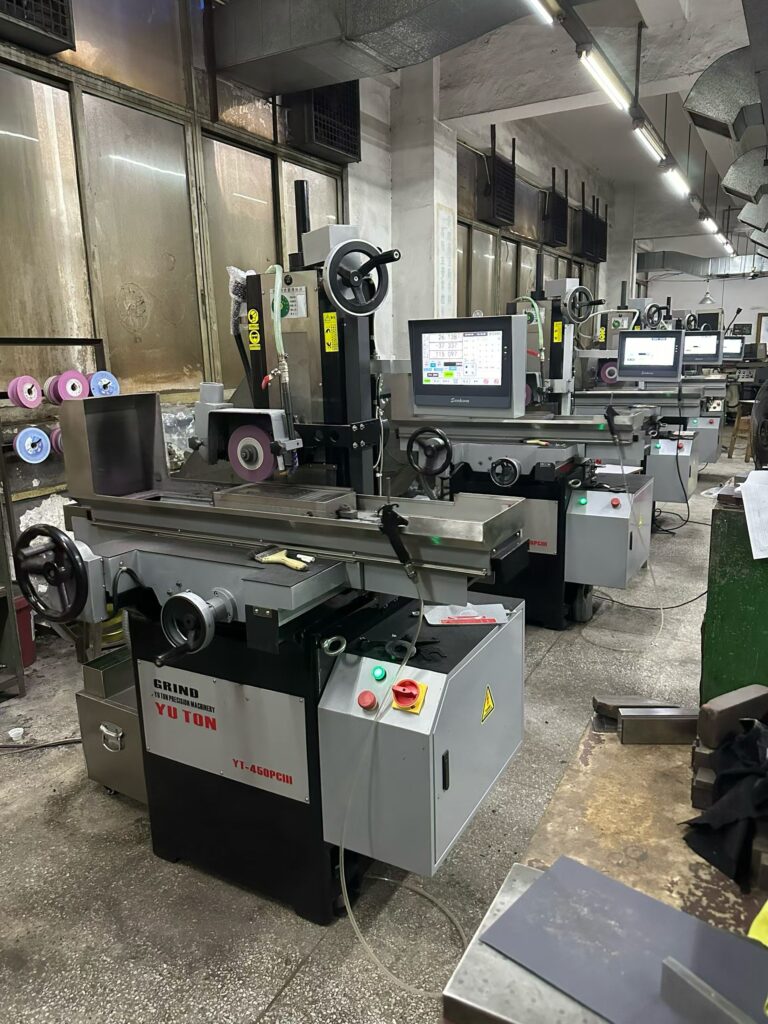
What Is Surface Grinding? Setup, Motion, and Capabilities
Surface grinding uses a rotating abrasive wheel to produce flat, parallel, dimensionally accurate surfaces. Moreover, it is the standard finishing process whenever a drawing calls for tight flatness or a low Ra value. Most shops know it as the last step before assembly or inspection.
Horizontal Spindle and Reciprocating Table
Most precision surface grinders use a horizontal spindle with a reciprocating rectangular table. Specifically, the wheel cuts with its outer periphery while the table slides back and forth beneath it. A cross-feed mechanism steps the wheel sideways after each pass. Consequently, the wheel lays down uniform, overlapping straight lines across the workpiece.
The work zone stays compact and tightly controlled. In addition, magnetic chucks, vacuum chucks, and precision vises clamp parts quickly and repeatably. For example, a steel blank locks to a magnetic chuck in seconds with no clamps to machine around. Non-magnetic parts use vacuum or mechanical fixturing instead.
Accuracy and Surface Finish
A rigid horizontal grinder reliably holds ±0.002 mm on production parts. Furthermore, skilled operators on fine machines can hold even tighter numbers through careful spark-out passes. Surface finishes of Ra 0.2–0.8 µm are routine with the right wheel and dressing routine. Our surface grinding tolerance guide explains how machine rigidity and heat control stack up. For finish benchmarks and Ra charts, see our surface grinding finish overview.
Typical Parts and Materials
This process fits mold blocks, die sets, cutting tools, gauges, way surfaces, and seal faces. In particular, it excels on hardened tool steel and carbide. Our notes on surface grinding for hardened steel cover wheel grit and coolant selection for those jobs. Furthermore, it grinds cast iron, stainless steel, and technical ceramics without a setup change. Small to medium parts dominate the work envelope. However, large hydraulic machines comfortably handle long beds, guideways, and plate work.
What Is Blanchard Grinding? The Rotary Surface Process
Blanchard grinding is a form of rotary surface grinding that dates back to the Blanchard Machine Company in the early 1900s. Specifically, it pairs a vertical spindle with a rotating circular table. The wheel grinds with its broad face rather than its periphery.
Vertical Spindle Meets Rotary Table
The workpiece mounts on a large magnetic rotary table. As the table spins, a segmented cup wheel descends and sweeps wide circular arcs over the part. Therefore, the wheel-to-part contact area is far larger than on any reciprocating machine. As a result, stock removal rates are dramatically higher, and flood coolant carries away the heavy heat.
Blanchard-style machines thrive on plate steel, sawed blanks, weldments, and rough castings. For example, surface grinding for cast iron often starts on a Blanchard to strip the hard sand-cast skin. The part then moves to a horizontal grinder for its critical datum faces. Non-magnetic workpieces need special fixturing, since the magnetic table cannot grip them directly.
The Signature Cross-Hatch Pattern
Blanchard grinding leaves a recognizable spiral or cross-hatch pattern of arcing scratch lines. Indeed, many buyers identify the process at a single glance. The pattern is harmless on structural plates and machine bases. However, it is not a fine precision finish. Thus, drawings rarely call for it on sealing or mating surfaces.
Tolerance and Finish Limits
Typical Blanchard results fall around ±0.005–0.025 mm flatness, with Ra values near 0.8–3.2 µm. These numbers depend heavily on machine age, wheel condition, and operator technique. Heat buildup can also distort thin plates during aggressive cuts. Consequently, most engineers treat Blanchard as a roughing or semi-finishing step rather than a final operation.
Surface Grinding vs Blanchard Grinding: Precision and Finish
The core trade in this head-to-head comparison is speed against accuracy. Moreover, the table below summarizes the key engineering differences at a glance.
| Factor | Horizontal Surface Grinding | Blanchard (Rotary) Grinding |
|---|---|---|
| Spindle orientation | Horizontal | Vertical |
| Table motion | Reciprocating, rectangular | Rotating, circular |
| Wheel contact | Wheel periphery | Wheel face |
| Typical tolerance | ±0.002 mm or better | ±0.005–0.025 mm |
| Surface finish | Ra 0.2–0.8 µm | Ra 0.8–3.2 µm |
| Stock removal rate | Moderate, controlled | Very high |
| Best part range | Small to medium, long parts | Large plates, castings |
| Surface pattern | Fine straight lines | Cross-hatch spiral |
| Typical role | Precision finishing | Roughing, semi-finishing |
| Batch fit | High-mix, precision work | Large lots of simple flats |
Tolerance Head-to-Head
Horizontal reciprocating grinding clearly wins on accuracy. It holds ±0.002 mm or better, and fine CNC models repeat within single microns. Blanchard grinding typically lands at ±0.005–0.025 mm under good conditions. Therefore, bearing seats, seal faces, and mating datums belong on a horizontal grinder. Meanwhile, large plates that only need to sit flat within a few hundredths of a millimeter suit Blanchard perfectly.
Surface Roughness and Function
Reciprocating grinding also delivers the finer Ra, often below Ra 0.8 µm with a fine-grit wheel. In addition, its straight-line finish supports sealing, sliding, and cosmetic requirements. Blanchard’s arcing cross-hatch is visibly coarser. As a result, functional fine faces almost always finish on a reciprocating machine, even when roughing happened on a rotary table.
Stock Removal, Part Size, and Batch Flexibility
Material Removal Rate
Blanchard grinding removes material several times faster than reciprocating surface grinding. The wide face wheel and continuous rotary contact hog scale, warp, and excess stock in far fewer passes. Thus, shops use it to clean up raw blanks quickly and at the lowest cost per cubic centimeter removed. Meanwhile, a reciprocating machine can remove the same volume eventually, but it would burn hours and wheels doing so.
Part Size and Shape
Blanchard tables commonly accept parts from 600 to 1,500 mm across, and special machines go larger still. Alternatively, horizontal grinders range from compact 150 × 450 mm manual models to 600 × 2,000 mm hydraulic machines. Long, narrow components such as guideways often grind better on a reciprocating table. Round or square plates, though, load naturally onto a rotary table with minimal setup.
Batch Size and Setup Flexibility
Reciprocating grinders are the more flexible platform across order types. For example, a manual machine handles one-off mold inserts with quick changeover. An automatic surface grinder or CNC surface grinder then runs repeat batches with minimal operator attendance. Blanchard machines favor large lots of simple flats, where setup time spreads across dozens of identical parts. Changeover between dissimilar jobs is slower on rotary equipment.
Cost, Footprint, and Operator Requirements
Machine Investment
Blanchard-style rotary grinders are big, heavy, and costly to buy, rig, and power. Horizontal grinders span a much wider price range, from entry-level manual units to full CNC forming grinders. In addition, their lower entry price lets smaller job shops bring precision grinding in-house instead of subcontracting it. Buyers should compare cost per finished part, not just the invoice price, since cycle time and scrap rate dominate the real expense. Energy use also differs sharply between the two platforms. The big vertical spindle draws far more power per hour than a precision horizontal machine. Therefore, shops that rarely process large plates often find subcontracting Blanchard work more economical than owning a rotary grinder.
Floor Space and Installation
A Blanchard needs deep foundations, generous ceiling height, and heavy three-phase power. A horizontal grinder fits a standard shop floor and ships as a rigid, self-contained unit. Therefore, capacity planning usually favors the horizontal layout for growing job shops. A hydraulic surface grinder delivers fully automatic feeds without the foundation and power demands of a rotary giant. Maintenance is also simpler, with wear parts that are widely available and easy to change.
Operator Skill and Quality Systems
Blanchard operation is relatively straightforward: set the downfeed, watch spark-out, and dress the segmented wheel. However, precision reciprocating grinding demands real craft in wheel dressing, coolant management, and workholding. PLC and CNC models automate the critical feeds and narrow the skill gap for new operators. Additionally, documented quality systems protect consistency from batch to batch. Standards such as ISO 9001 and the CE marking framework give buyers audited assurance of a supplier’s processes. For deeper reading, organizations like SME and AMT cover abrasive machining extensively, and publications such as Modern Machine Shop track the latest grinding technology.
How to Choose: Decision Tree and When Shops Need Both
The Five-Question Decision Tree
Answer these questions in order to route any job correctly. First, does the part need tighter than ±0.005 mm or a finish finer than Ra 0.8 µm? If yes, choose horizontal reciprocating grinding. Second, is it a large plate, weldment, or casting carrying heavy stock? If yes, start with Blanchard grinding. Third, does a large part still need a fine sealing or mating face? Rough it on the Blanchard, then finish it on a horizontal grinder. Fourth, is the job one-off or high-mix? Choose the flexible horizontal platform. Fifth, is it a large batch of simple, generous-tolerance flats? Blanchard often wins on cost per part.
Why Strong Shops Run Both
Indeed, the two processes are complementary rather than competing. Blanchard grinding removes bulk stock quickly and cheaply. Horizontal grinding then delivers final precision and surface quality. As a result, efficient shops rough on rotary machines and finish on reciprocating ones. This two-step route cuts both cycle time and scrap risk, and it explains why so many contract manufacturers keep both on the floor.
Where YUTON Fits
YUTON — Guangdong Yutong Precision Machinery Co Ltd — builds high-precision horizontal reciprocating surface grinders in Dongguan, China. Our 150-person team works across a 15,000 m² campus of seven factory buildings. Furthermore, we hold ISO 9001 and CE certification, and we source core components from leading suppliers in Japan, Taiwan, and the United States.
Additionally, our product range covers manual surface grinders, hydraulic automatic grinders, PLC auto-manual models, CNC forming grinders, and milling machines. In 2025 we shipped 3,100 machines, placing us among China’s top three surface grinder manufacturers. If the precision side of the surface grinding vs Blanchard grinding decision is your shop’s current gap, browse our surface grinders for sale or contact our team for a tailored capacity and model recommendation.
FAQ: Surface Grinding vs Blanchard Grinding
Is Blanchard grinding the same as surface grinding?
Blanchard grinding is a subset of surface grinding, specifically rotary surface grinding with a vertical spindle and rotating table. However, when machine shops say “surface grinding,” they usually mean horizontal spindle, reciprocating table grinding. Thus, the two terms describe different machine layouts within one broad process family.
Which process is more accurate?
Horizontal reciprocating surface grinding is the more accurate option. It holds ±0.002 mm or better in production, while Blanchard grinding typically reaches ±0.005–0.025 mm. Therefore, precision datums, seal faces, and mating surfaces should always finish on a horizontal grinder.
Can Blanchard grinding replace surface grinding?
It cannot fully replace reciprocating surface grinding. Blanchard grinding removes stock fast on large plates and castings, but its tolerance and finish are coarser. Consequently, most shops use Blanchard for roughing and a horizontal grinder for final precision work.
What does the Blanchard grind pattern look like?
It leaves a distinctive cross-hatch or spiral pattern of arcing scratch lines. This pattern comes from the rotating face wheel sweeping across a spinning table. In addition, it instantly signals that a part was rotary-ground rather than reciprocating-ground.
How do I choose between the two processes?
Start with the drawing’s tolerance and finish requirements. If you need tighter than ±0.005 mm or finer than Ra 0.8 µm, choose reciprocating surface grinding. Alternatively, large parts with heavy stock and looser specs suit Blanchard grinding. For tight specs on big parts, run both processes in sequence.
Conclusion
The surface grinding vs Blanchard grinding decision comes down to one principle: match the machine to the tolerance, stock, and size of the part. Blanchard grinding wins on raw removal speed and large-plate economics. Moreover, horizontal reciprocating grinding wins on precision, finish, and job flexibility.
For most shops, the answer is not “either/or.” Indeed, the strongest setups use Blanchard for fast roughing and high-precision horizontal grinders for finishing. At YUTON, we focus squarely on that finishing side. Our rigid, certified machines use Japanese, Taiwanese, and American core components, and they are built by a 150-person team in our 15,000 m² Dongguan factory. We shipped 3,100 units in 2025 and rank among China’s top three makers, with ISO 9001 and CE certification behind every machine. Therefore, when micron-level accuracy matters, talk to YUTON before your next grinder purchase.