
Hardened steel is one of the most common materials processed on surface grinders — and one of the most demanding. Parts hardened to HRC 50-65 resist cutting, generate high grinding temperatures and crack easily if parameters are wrong. Therefore, this guide covers the techniques that produce flat, burn-free surfaces on hardened steel workpieces consistently.
Why Hardened Steel Needs Surface Grinding
After hardening, steel parts carry residual stress, distortion and scale that machining alone cannot correct. Turning and milling leave tool marks and fail to achieve the flatness and surface finish that functional surfaces demand. Consequently, surface grinding solves these problems by removing thin, controlled layers of material with a precision grinding wheel:
- Flatness within 0.003mm over 300mm — essential for die faces, guide ways and sealing surfaces
- Surface roughness below Ra 0.2 μm — required for bearing seats, gauge blocks and precision references
- Dimensional accuracy that heat treatment distortion destroyed — restoring parts to drawing tolerance
Common hardened steel parts that require surface grinding include mold bases, die plates, cutting tool blanks, machine guide ways, thrust washers and gauge blocks. If your shop grinds any of these, the techniques in this guide apply directly.
Challenges of Grinding Hardened Steel
Grinding hardened steel presents three primary challenges that softer materials do not:
- High grinding forces. Hardened steel resists wheel penetration. Therefore, the grinding wheel must fracture abrasive grains to maintain cutting sharpness, requiring wheels with the right grain type, bond strength and friability.
- Thermal damage risk. Hardened steel has low thermal conductivity compared to soft steel. Heat concentrates at the grinding zone instead of dissipating into the workpiece. Moreover, without proper coolant and parameters, surface temperatures exceed the tempering threshold — typically 200°C — causing grinding burn that softens the surface layer. This burn is invisible but detectable with nital etch testing.
- Cracking and chipping. Hardened steel is brittle. Rapid temperature changes create thermal gradients that induce tensile stress in the surface layer. Furthermore, if this stress exceeds the fracture strength, the part cracks — often after grinding is complete. Thin parts and parts with sharp corners are especially vulnerable.
Wheel Selection for Hardened Steel
Choosing the right grinding wheel is the first and most important decision.
Abrasive Type
Aluminum oxide (Al₂O₃) wheels grind most hardened tool steels effectively. White aluminum oxide (WA) and single-crystal aluminum oxide (SA) provide sharp, friable grains. Moreover, for steels above HRC 60, micro-crystalline aluminum oxide (SG or TG) grains offer superior self-sharpening performance.
However, for very hard materials above HRC 63 — such as M2 high-speed steel — cubic boron nitride (CBN) wheels deliver dramatically higher removal rates and longer wheel life. Furthermore, CBN conducts heat into the wheel rather than the workpiece, reducing burn risk. Therefore, CBN wheels cost more initially but often reduce total grinding cost by 30-50%.
Grit Size and Bond
For roughing passes, 46-60 grit wheels remove material at practical rates. For finishing passes targeting Ra 0.2 μm or finer, 80-120 grit wheels produce the required surface quality. Moreover, vitrified bonds are standard for surface grinding hardened steel — they hold grains securely while allowing controlled fracture for self-sharpening.
The Grinding Wheel Institute publishes wheel selection charts for hardened materials — see https://www.grindingwheelinstitute.com/.
Grinding Parameters for Hardened Steel
Setting the right parameters prevents burn, cracking and poor finish.
Wheel and Table Speed
Standard aluminum oxide wheels run at 30-35 m/s peripheral speed. CBN wheels can run at 45-60 m/s for higher removal rates. Furthermore, for roughing, table speeds of 15-20 m/min work well. However, for finishing, reduce to 10-15 m/min. Surface grinders from https://surfacegrindermfg.com/ support standard wheel speeds for both aluminum oxide and CBN applications.
Infeed Depth and Dressing
Roughing passes typically use 0.01-0.03mm infeed per pass. Finishing passes reduce to 0.005-0.01mm. Moreover, for final spark-out passes, set zero infeed and let the wheel make 2-3 passes to clean up the surface. The key principle: light infeed, moderate table speed, full coolant.
Therefore, dress the wheel before starting and whenever force or finish deteriorate. A sharp, well-dressed wheel cuts cleanly with minimum heat. However, a dull or loaded wheel generates heat and produces poor results on hardened steel.
Coolant Management for Hardened Steel Grinding
Coolant is not optional when grinding hardened steel — it is essential.
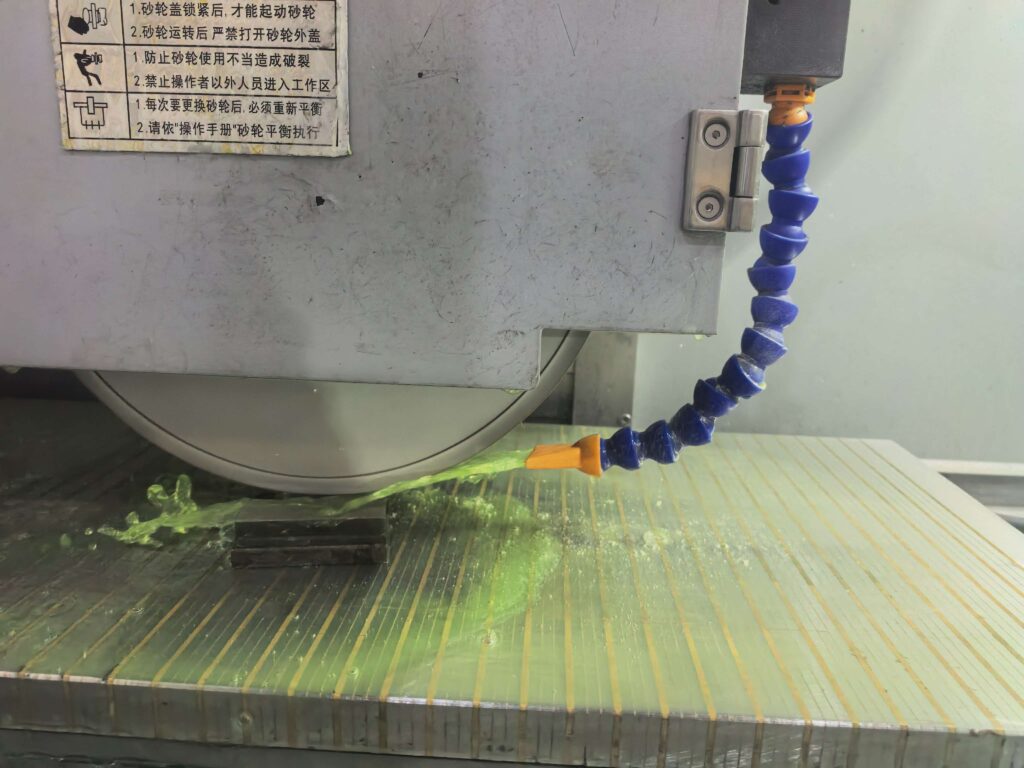
- Flood coolant at adequate flow. Provide 20-40 liters per minute directed at the grinding zone. Inadequate coolant is the single most common cause of grinding burn on hardened steel.
- Use the right fluid. Water-soluble oils with extreme pressure additives (sulfur or chlorine) provide the lubrication needed. Concentrations of 1:20 to 1:30 offer a good balance. For the finest finish, some shops switch to straight grinding oil for maximum lubrication.
- Keep coolant clean. Chips and debris in the coolant score the workpiece surface. Effective filtration removes contaminants before they recirculate.
- Avoid interrupted flow. Intermittent coolant causes thermal shock that cracks hardened steel. Therefore, ensure flow is steady and continuous throughout the pass.
Preventing Cracks in Hardened Steel Parts
Cracking is the most serious risk. Follow these practices to prevent it:
- Never grind dry. Dry grinding concentrates heat at the surface while the core remains cool. The thermal gradient creates tensile stress that exceeds fracture strength.
- Avoid heavy infeed on thin parts. Thin parts (under 10mm) heat rapidly. Use lighter infeed — 0.005-0.015mm per pass. Hydraulic surface grinders from https://surfacegrindermfg.com/hydraulic-surface-grinder/ deliver the controlled infeed that thin parts require.
- Grind both sides symmetrically. Alternate sides rather than finishing one completely first. Symmetric removal balances residual stress and prevents warping.
- Etch test critical parts. Apply nital etch to check for grinding burn. A dark-etching band indicates a thermally damaged soft layer. The International Organization for Standardization defines burn detection standards — see https://www.iso.org/.
Step-by-Step: Grinding a Hardened Die Plate
This procedure demonstrates a typical job — D2 tool steel die plate at HRC 58-62, 200mm × 150mm × 30mm:
- Inspect the part. Check hardness with a Rockwell tester. Verify bottom surface flatness. Clean part and chuck thoroughly.
- Set up workholding. Place on fine-pole electromagnetic chuck. Add mechanical stop block. Activate and verify secure hold.
- Dress the wheel. Dress 60-grit WA vitrified wheel with single-point diamond at 0.15mm/rev traverse and 0.03mm infeed.
- Rough at 0.02mm infeed, 18 m/min table speed, 1.5mm crossfeed. Remove 0.1-0.3mm total with continuous flood coolant.
- Intermediate dress lightly before finishing to restore sharpness.
- Finish at 0.005mm infeed, 12 m/min table speed, 0.8mm crossfeed. Make 4-6 passes.
- Spark-out at zero infeed for 2-3 passes.
- Check results — flatness, surface finish and nital etch test for critical parts.
Manual surface grinders from https://surfacegrindermfg.com/manual-surface-grinder/ give experienced operators the control to execute this process precisely.
YUTON Surface Grinders for Hardened Steel Work
YUTON specializes in surface grinders built for the demands of precision grinding — including hardened steel. Moreover, every machine features Meehanite cast iron construction with spindle bearings and core components from leading Japanese, Taiwanese and American suppliers. Therefore, this build quality ensures the rigidity and vibration damping that hard-material grinding demands.
With 150 employees, 15,000 square meters across 7 buildings in Dongguan, and 3,100 machines produced in 2025, YUTON ranks among China’s top three surface grinder manufacturers. Furthermore, ISO 9001 and CE certifications confirm every machine meets consistent quality standards before shipment.
For hardened steel grinding specifically: manual models provide operator control for toolroom work; hydraulic models deliver stable force for production roughing and finishing; automatic models boost efficiency for batch production; CNC models handle complex geometries and programmable cycles. Visit https://surfacegrindermfg.com/ to explore the full range. The American Society of Mechanical Engineers publishes grinding standards for hardened materials — see https://www.asme.org/.
FAQ: Surface Grinding for Hardened Steel
What wheel grit should I use for hardened steel?
Roughing: 46-60 grit aluminum oxide. Finishing: 80-120 grit. For steels above HRC 63, consider CBN wheels for faster cutting and longer life.
How do I prevent grinding burn on hardened steel?
Use flood coolant continuously, keep infeed light (0.005-0.03mm), dress the wheel frequently, and never grind dry. Check with nital etch if burn is a concern.
Can I use CBN wheels on a standard surface grinder?
Yes, if the wheel speed rating matches the machine’s spindle speed. However, verify that the machine can accommodate the wheel size and mounting. CBN wheels often require different flanges.
Why do hardened parts crack after grinding?
Thermal shock from interrupted coolant, excessive infeed on thin parts, or residual stress from heat treatment. Always grind with continuous coolant and light infeed on hardened parts.
What is the best coolant for hardened steel grinding?
Water-soluble oil with extreme pressure (EP) additives at 1:20 to 1:30 concentration. The EP additives provide the lubrication needed for hard-material cutting.
Conclusion
Surface grinding hardened steel successfully requires the right wheel, the right parameters and the right machine. Therefore, use aluminum oxide or CBN wheels matched to the steel hardness. Moreover, keep infeed light, table speed moderate and coolant flowing continuously. Furthermore, dress the wheel frequently and test critical parts for burn. Consequently, for a surface grinder with the spindle rigidity and thermal stability that hard-material grinding demands, explore YUTON’s range at https://surfacegrindermfg.com/.