
In industrial surface grinding, the 618S surface grinder is often evaluated incorrectly because specification sheets describe ideal conditions rather than real production accuracy in surface grinding machines.
The real question experienced engineers ask is not:
“What is the machine accuracy of a surface grinder?”
but:
“What accuracy can still be maintained after thermal load, vibration, and operator variation over time in a precision surface grinding machine?”
The 618S surface grinder is developed around this evaluation logic, focusing on repeatable precision under continuous production conditions, not laboratory calibration results. It is designed as a 2 micron grinding system for industrial manufacturing environments where stability matters more than peak performance.
Why Specified Accuracy Does Not Equal Real Production Accuracy in Surface Grinder Systems
In controlled factory inspection, surface grinders are typically measured under:
short cycle operation
stable ambient temperature (20°C ±1°C)
minimal load variation
freshly dressed wheel condition
Under these conditions, a high precision surface grinding machine can easily achieve micron-level results.
However, in real industrial manufacturing, the behavior of a grinding system machine changes due to accumulated disturbances:
1. Thermal Load Accumulation in Surface Grinder Operation
Spindle and motor heat gradually shift machine geometry in any precision surface grinding machine.
spindle temperature rise: continuous
structural expansion in cast iron body: non-linear
alignment drift: progressive over time
👉 Even a few degrees of thermal drift can generate micron-level deviation in a grinding system for precision machining applications.
2. Dynamic Vibration Interaction in Industrial Surface Grinding
Vibration in a surface grinder machine is not constant—it amplifies under:
reciprocating table motion
uneven grinding resistance
wheel imbalance after wear
👉 This creates micro-deflection during actual cutting engagement in any industrial surface grinding process.
3. Tool Wear and Dressing Cycle Variation in Surface Grinding Machine
Grinding wheel condition directly affects performance of a precision surface grinding machine:
cutting force stability
surface finish consistency
load distribution on guideways
4. Operator Dependency Factor in Surface Grinder Operation
Different operators introduce variation in surface grinding machine accuracy:
feed pressure
spark-out timing
dressing frequency
👉 This is often the hidden source of batch inconsistency in industrial surface grinder applications.
Engineering Strategy Behind 618S Surface Grinder Stability Design
The 618S surface grinder does not rely on a single precision element, but on system-level stability control required in a high precision surface grinding machine.
1. Structural Rigidity in Cast Iron Surface Grinder Frame
The machine frame uses stress-relieved cast iron with long-cycle aging treatment, typical of a heavy-duty surface grinder structure.
Engineering purpose:
reduce micro elastic deformation in surface grinder machine body
suppress vibration resonance frequency shift
maintain geometric alignment under load
2. Hand-Scraped Guideway Contact Stability in Precision Surface Grinder
Guideway surfaces are hand-scraped, a critical process in precision surface grinding machine manufacturing.
This improves:
load distribution uniformity
lubrication film stability
long-term wear resistance in grinding system operation
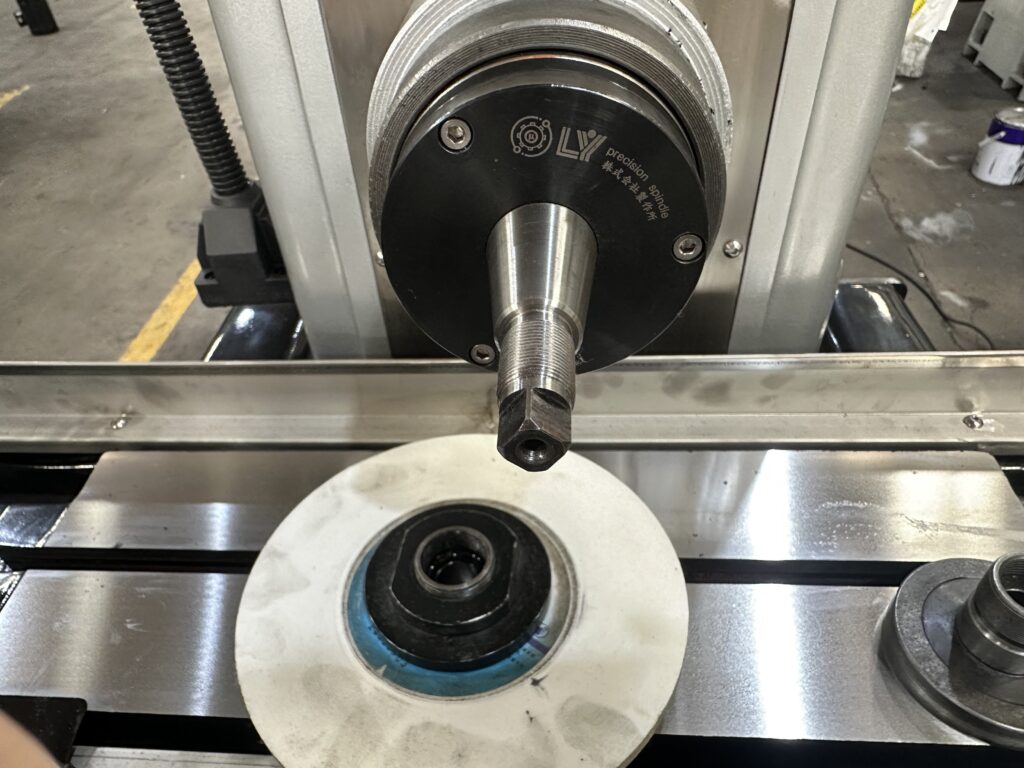
3. Spindle Runout Control System in 618S Surface Grinder
Instead of idle testing, the spindle is evaluated under load in real surface grinding machine conditions:
radial runout stability during grinding engagement
thermal expansion compensation behavior
vibration damping response curve
4. Thermal Drift Control in High Precision Surface Grinding Machine
Thermal behavior in the 618S surface grinder is controlled by:
structural symmetry design
heat flow dispersion paths
reduced localized heat concentration zones
If you are evaluating a high precision surface grinding machine for production use, you can check the 618S surface grinder specifications and configuration details here.
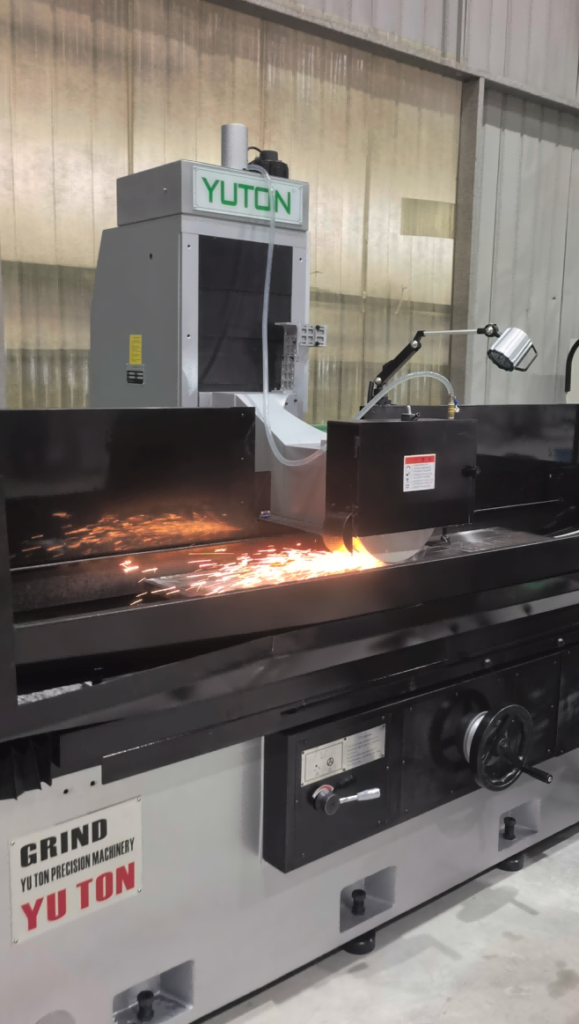
Measured Production Stability of 618S Surface Grinder (Factory Test Reference)
Under continuous grinding cycle conditions (steel workpiece, standard coolant, 6-hour run), this precision surface grinding machine shows:
initial calibration accuracy: within 2 μm
after 3 hours: no measurable deviation trend
after 6 hours: drift maintained within controlled micron range
surface consistency: stable across batch samples
👉 This reflects real surface grinder accuracy stability in production environments.
618 vs 618S Surface Grinder – Behavioral Difference Under Load
| Performance Factor | Standard 618 | 618S Surface Grinder |
|---|---|---|
| Short-cycle accuracy | Good | Excellent |
| Long-cycle stability | Degrades faster | Controlled degradation |
| Thermal drift response | Noticeable | Suppressed |
| Vibration accumulation | Progressive increase | Stabilized response curve |
| Batch consistency | Medium | High |
| Production suitability | General workshop use | Precision production line |
👉 The difference between 618 and 618S surface grinder is not peak accuracy, but accuracy stability in production grinding conditions.If you are comparing surface grinder options for production use, feel free to contact us for technical recommendations and pricing.
Where 618S Surface Grinder Is Technically Necessary
The 618S surface grinder for industrial manufacturing becomes critical in environments where:
tolerance stack-up is strict in assembly parts
mold surface flatness must be repeatable
multi-shift production requires stability
rejection rate cost is high in mass production
Engineering Interpretation of “2 Micron Surface Grinder Precision”
In production engineering terms, “2 micron precision” in a surface grinding machine is not a static measurement.
It represents:
repeatability under thermal influence
geometric stability under vibration
motion consistency across cycles
minimal drift accumulation over time
Technical Reference Data (618S Surface Grinder)
Model: 618S Surface Grinder
Table travel: 150 × 450 mm
Spindle speed: 2850 rpm
Structure: stress-relieved cast iron frame (heavy-duty surface grinder design)
Operation mode: manual / semi-auto
Grinding accuracy: up to 2 μm (controlled condition)
Evaluation basis: continuous cycle test (internal factory standard)
Pre-Purchase Questions for Surface Grinding Machine Buyers
Experienced buyers evaluating a precision surface grinding machine usually ask:
How does accuracy behave after 6–8 hours of continuous grinding in a surface grinder?
What is the drift pattern under thermal load in industrial surface grinding?
How stable is repeatability across operators in a surface grinder machine?
What is the failure mode of accuracy loss in precision grinding machines?
Final Engineering Conclusion
In precision surface grinding, peak accuracy is not the challenge.
The real engineering challenge in a surface grinder machine is maintaining stability when heat, vibration, wear, and human factors begin to interact simultaneously.
The 618S surface grinder is designed specifically to manage this interaction system in industrial manufacturing environments.
If you need detailed test data or application guidance, feel free to contact us.
FAQ
Yes, but only when thermal, structural, and vibration variables are simultaneously controlled.
Thermal drift combined with vibration accumulation over time is the dominant failure mechanism.
Because heat distribution changes machine geometry gradually, not instantly.
Yes. Operator behavior directly affects dressing cycle and feed stability, which influence final tolerance.
Yes. It is designed for long-cycle industrial grinding environments where stability is critical.