
Introduction
Modern manufacturing is moving rapidly toward automation, digital production, and intelligent processing. Among these changes, surface grinding automation has become a key technology helping manufacturers achieve higher precision, lower production costs, and more stable quality.
The global grinding machinery market continues to expand as industries such as automotive, aerospace, mold manufacturing, medical devices, and precision engineering demand tighter tolerances and higher productivity.
Unlike traditional manual grinding operations, automated grinding solutions combine precision mechanical structures, CNC control systems, intelligent monitoring, and advanced process management to deliver consistent surface quality during long production cycles.
With more than 15 years of grinding machine manufacturing experience, YUTON provides reliable automated grinding solutions designed for global manufacturers seeking precision, efficiency, and long-term stability.
What Is Surface Grinding Automation?
Surface grinding automation refers to the integration of automatic control systems, precision grinding equipment, and intelligent production technologies to reduce manual operation during the grinding process.
Traditional grinding relies heavily on operator experience for:
- Workpiece positioning
- Grinding parameter adjustment
- Wheel dressing control
- Quality inspection
However, automated grinding systems can complete these processes through programmed control and repeatable production cycles.
A modern automated grinding solution typically includes:
- CNC or PLC control systems
- Automatic feed control
- Precision servo positioning
- Automatic wheel dressing
- Digital process monitoring
As a result, manufacturers achieve higher consistency, improved efficiency, and reduced dependence on skilled operators.
Why Manufacturers Are Investing in Surface Grinding Automation
1. Increasing Demand for Precision Manufacturing
Industries such as automotive, aerospace, electronics, and medical equipment require extremely accurate components.
Typical applications include:
- Precision molds
- Guide rails
- Bearing components
- Hydraulic parts
- EV components
- Aerospace structural parts
These applications require excellent:
- Flatness
- Parallelism
- Surface finish
- Dimensional stability
Therefore, surface grinding automation has become an important solution for maintaining production accuracy.
2. Shortage of Skilled Grinding Operators
Precision grinding has traditionally depended on experienced technicians.
However, many manufacturers face challenges including:
- Difficult skilled labor recruitment
- Increasing labor costs
- Operator training requirements
- Production consistency issues
Automation helps solve these problems by standardizing grinding processes.
One operator can supervise multiple machines, improving production capacity while reducing labor pressure.
3. Industry 4.0 and Smart Manufacturing Development
Modern factories are moving toward connected and intelligent production environments.
Automated grinding systems can support:
- Real-time production monitoring
- Digital parameter management
- Data collection
- Predictive maintenance
This makes grinding equipment easier to integrate into smart manufacturing systems.
Key Benefits of Surface Grinding Automation
Improved Grinding Accuracy
Precision stability is one of the biggest advantages of automated grinding.
A high-quality automated grinding machine maintains consistent performance through:
- Rigid cast iron structures
- Precision spindle systems
- Servo-controlled movement
- Stable thermal design
YUTON CNC and PLC grinding machines are manufactured using high-quality components from Japan, Taiwan, Germany, and the United States to ensure long-term accuracy.
Higher Production Efficiency
Manual grinding operations often require repeated adjustments and inspections.
Automation reduces unnecessary downtime by optimizing:
- Grinding cycles
- Feed movement
- Workpiece positioning
- Wheel maintenance
The result is:
- Faster production
- Lower scrap rates
- Improved machine utilization
For manufacturers producing medium and large batches, automated grinding can significantly improve overall productivity.
Lower Manufacturing Costs
Although automation requires an initial investment, it can reduce long-term production costs.
Major savings come from:
- Reduced labor dependency
- Fewer rejected parts
- Lower setup time
- Improved machine utilization
Many manufacturers achieve faster return on investment by upgrading from manual grinding to automated systems.
YUTON Automated Grinding Solutions
YUTON provides a complete range of grinding solutions for different production requirements.
Manual Precision Grinding Machines
Suitable for:
- Tool rooms
- Maintenance departments
- Small batch production
Models include:
- YT-450G
- YT-618G
- YT-618S
- YT-618SA
These machines provide reliable precision for manufacturers requiring flexible operation.
PLC Semi-Automatic Grinding Machines
PLC grinding solutions are ideal for manufacturers transitioning from manual operation to automation.
Advantages include:
- Automatic grinding cycles
- Stable batch production
- Easy operation
- Cost-effective automation
The YT-450PCIII PLC surface grinder is designed for manufacturers requiring improved efficiency without the complexity of full CNC systems.
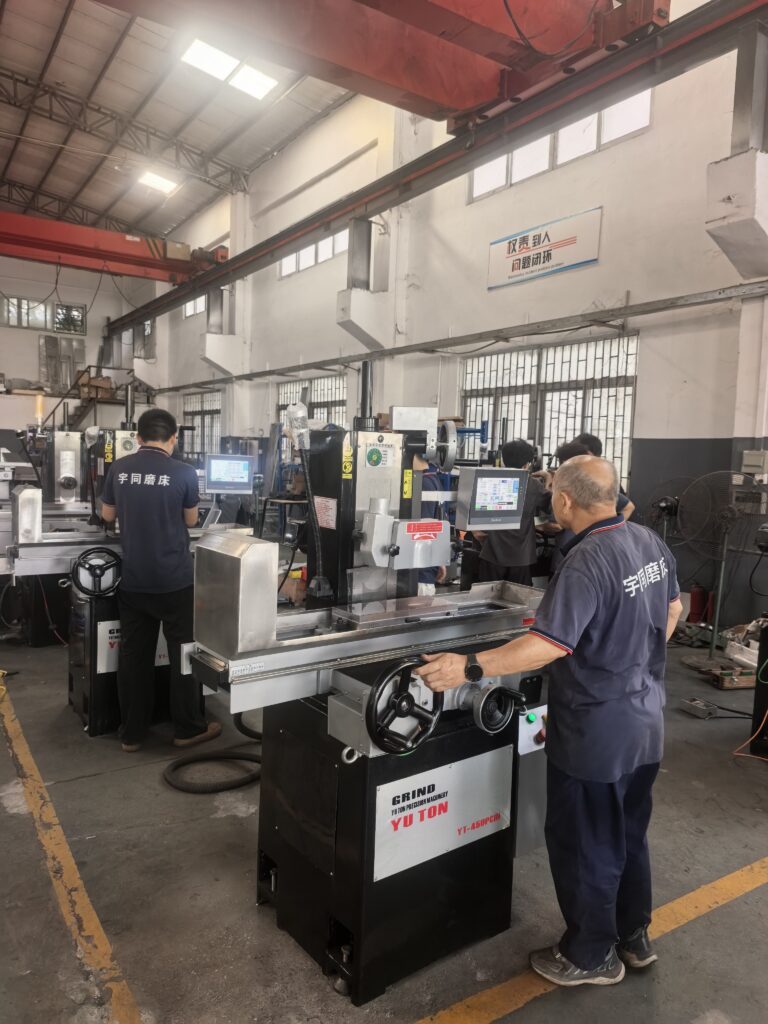
CNC Automated Grinding Machines
For high-volume and precision manufacturing, CNC grinding systems provide:
- Programmable grinding cycles
- Higher repeatability
- Complex process control
- Reduced operator involvement
YUTON CNC models such as YT-40100CNC provide large working capacity and precision performance for demanding industrial applications.
Four Important Factors When Choosing Automated Grinding Equipment
1. Machine Precision Requirements
Before selecting equipment, manufacturers should define:
- Required tolerance
- Surface roughness target
- Production volume
- Material type
Different industries require different precision levels.
For example:
| Application | Typical Requirement |
|---|---|
| General machining | ±0.01mm |
| Mold manufacturing | ±0.005mm |
| Precision components | ±0.002mm |
2. Automation Level
The correct automation level depends on production needs.
Manual Grinding
Suitable for:
- Low-volume production
- Repair work
- Flexible machining
PLC Automation
Suitable for:
- Medium batch production
- Repetitive grinding operations
CNC Automation
Suitable for:
- Large production volumes
- Complex grinding requirements
- Smart factories
3. Machine Reliability
For overseas buyers, equipment reliability is a critical purchasing factor.
Important evaluation points include:
- Manufacturing experience
- Quality control system
- Component suppliers
- Certification compliance
- After-sales service
4. Supplier Support Capability
International customers need more than just equipment.
They require:
- Installation guidance
- Technical training
- Spare parts support
- Remote assistance
YUTON supports customers in more than 50 countries with professional technical service and export experience.
Why Choose YUTON Surface Grinding Solutions?
YUTON Precision Machinery is a professional grinding machine manufacturer located in Dongguan, China.
Our manufacturing advantages include:
- Over 15 years of grinding experience
- 7 factory buildings
- 15,000㎡ production area
- More than 150 employees
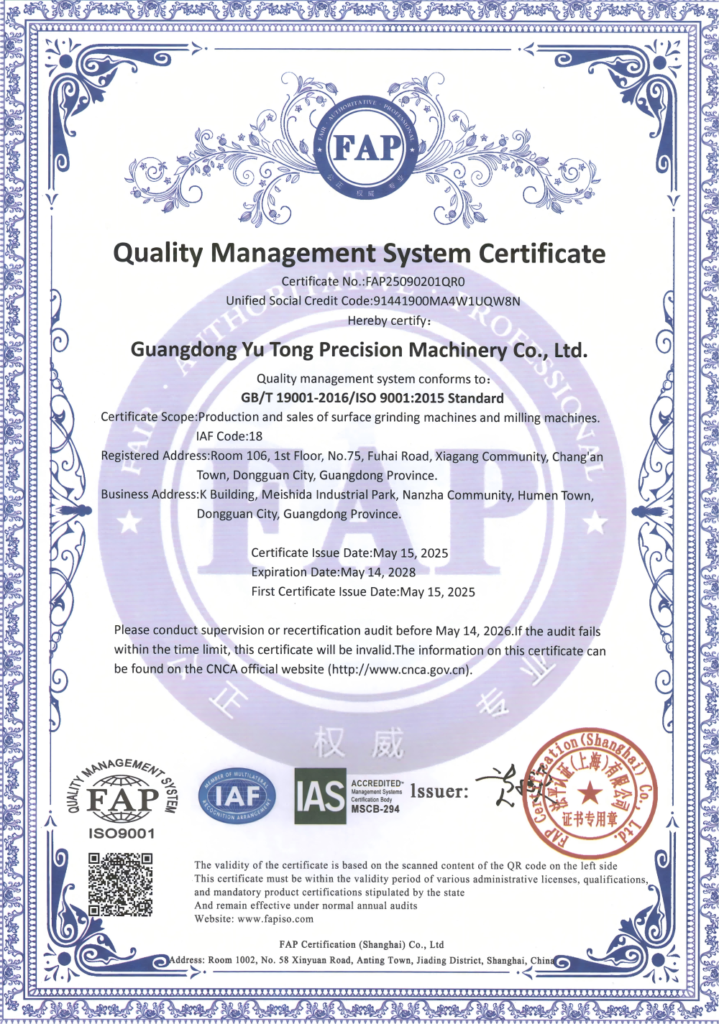
- ISO 9001 quality management system
- CE-compliant manufacturing
- Over 3,100 machines sold worldwide in 2025
YUTON focuses on providing stable, high-precision grinding solutions for distributors, machine dealers, and manufacturing companies worldwide.
Our machines use carefully selected core components from international suppliers to ensure reliability, accuracy, and long service life.
Frequently Asked Questions
What is surface grinding automation?
Surface grinding automation uses automatic control technology to reduce manual operation and improve grinding accuracy, efficiency, and production consistency.
What are the benefits of automated grinding systems?
The main benefits include higher precision, reduced labor costs, improved productivity, and stable production quality.
Is automation suitable for small factories?
Yes. Small and medium manufacturers can select PLC or compact automated grinding solutions according to production requirements and investment plans.
How does automation improve grinding accuracy?
Automation reduces human operation errors by controlling grinding parameters, positioning, and production cycles with high repeatability.
What industries use automated grinding technology?
Common industries include automotive, aerospace, mold manufacturing, medical equipment, electronics, and precision engineering.
Conclusion
Surface grinding automation is becoming an essential technology for manufacturers seeking higher precision, improved productivity, and lower production costs.
By combining advanced control systems, precision mechanical design, and intelligent manufacturing concepts, automated grinding solutions help companies remain competitive in a rapidly changing industrial environment.
With strong manufacturing capability, ISO 9001 quality management, CE compliance, and worldwide export experience, YUTON provides dependable grinding solutions for customers requiring stable performance and long-term value.
Contact YUTON today to discuss your automated grinding requirements and receive a customized recommendation.