
Manufacturing companies worldwide are facing the same challenge: rising labor costs, increasing quality requirements, and a shortage of skilled grinding operators. As a result, more factories are exploring grinding automation as a practical way to remain competitive.
Traditionally, automation projects required large investments, complex programming, and specialized engineering teams. Today, however, collaborative grinding systems and plug-and-play automation solutions have dramatically lowered the entry barrier for small and medium-sized manufacturers.
This guide explains how grinding automation helps SMEs improve productivity, maintain precision, reduce operating costs, and comply with international safety standards while achieving a fast return on investment.
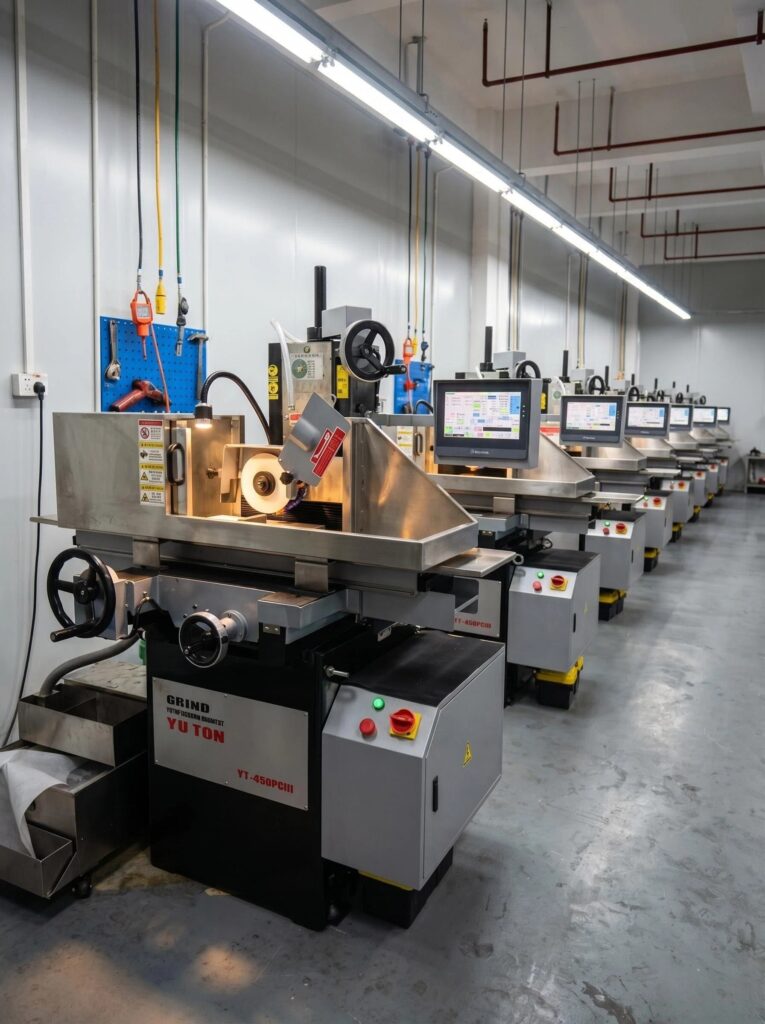
What Is Grinding Automation?
Grinding automation refers to the use of intelligent systems, CNC controls, PLC technology, collaborative robots, and automated workpiece handling solutions to perform grinding operations with minimal manual intervention.
Unlike traditional grinding processes that depend heavily on operator experience, automated systems deliver consistent quality, predictable cycle times, and higher productivity.
Modern grinding automation solutions typically include:
- CNC surface grinding machines
- PLC automatic grinding machines
- Collaborative robotic grinding workstations
- Automated loading and unloading systems
- AI-assisted process monitoring
- Closed-loop quality control systems
Consequently, manufacturers can achieve higher efficiency while reducing dependence on skilled labor.
Why SMEs Are Investing in Grinding Automation
Many factory owners assume automation is only suitable for large enterprises. However, modern automation platforms are specifically designed to support high-mix, low-volume production environments.
Several factors are driving adoption:
Labor Shortages
Finding experienced grinding technicians has become increasingly difficult. Furthermore, labor costs continue to rise across global manufacturing markets.
Automation reduces dependence on highly skilled operators while maintaining production stability.
Quality Consistency
Manual grinding often produces variations between operators and shifts. By contrast, automated systems maintain consistent process parameters throughout production.
As a result, manufacturers experience fewer defects, lower scrap rates, and improved customer satisfaction.
Faster Production
Automated grinding systems reduce setup times and improve machine utilization.
Moreover, collaborative robotic systems can operate continuously with minimal supervision.
Lower Long-Term Costs
Although automation requires initial investment, reduced labor expenses and improved efficiency often generate significant savings.
Most manufacturers achieve ROI within 12 to 18 months.
Common Challenges When Choosing Grinding Automation
Selecting the Right Equipment
Factory managers are often overwhelmed by the number of available solutions.
Options include:
- Manual surface grinders
- PLC automatic grinders
- CNC surface grinders
- Robotic grinding systems
- Collaborative grinding workstations
Instead of focusing solely on automation level, buyers should evaluate:
- Workpiece dimensions
- Material type
- Surface finish requirements
- Production volume
- Operator skill level
A structured evaluation process significantly reduces investment risk.
Budget Constraints
Traditional fully automated production lines often require substantial capital investment.
Fortunately, modular grinding automation allows manufacturers to upgrade gradually.
For example, many companies begin with PLC-controlled grinding machines before transitioning to fully integrated CNC systems.
This phased approach reduces financial pressure while delivering measurable productivity improvements.
Precision Requirements
A common concern is whether automation can maintain precision.
The answer is yes.
Modern grinding automation systems equipped with force-control technology and closed-loop feedback systems routinely achieve excellent accuracy and repeatability.
For precision-critical industries such as aerospace, mold manufacturing, medical devices, and electronics, automated grinding often outperforms manual operations.
After-Sales Support
Equipment downtime directly impacts profitability.
Therefore, selecting a supplier with strong technical support and global service capabilities is essential.
A reliable supplier should provide:
- Remote diagnostics
- Technical documentation
- Spare parts availability
- Fast response times
- Installation support
How Collaborative Grinding Is Transforming Manufacturing
Collaborative grinding systems combine robotic automation with user-friendly operation.
Unlike traditional industrial robots that require advanced programming knowledge, collaborative systems are designed for rapid deployment.
Key advantages include:
Simplified Programming
Modern collaborative systems utilize touchscreen interfaces and guided workflows.
Consequently, operators can learn basic operation within days instead of months.
Faster Changeovers
Manufacturers producing multiple product types benefit significantly from quick setup changes.
Collaborative systems can reduce changeover times from hours to minutes.
Improved Quality Control
Integrated sensors continuously monitor force, position, and process conditions.
As a result, production quality remains stable even during extended operation.
Enhanced Workplace Safety
Collaborative systems are specifically designed to operate safely alongside human workers.
Therefore, they help manufacturers improve both productivity and workplace safety.
International Compliance and Safety Standards
For export-oriented manufacturers, compliance is no longer optional.
Grinding equipment entering global markets must meet applicable safety and quality requirements.
CE Certification
Manufacturers exporting to Europe must comply with CE requirements.
Official guidance is available through the European Commission:
CE compliance demonstrates that equipment meets essential safety, health, and environmental requirements.
EN ISO 16089:2025
The latest EN ISO 16089 standard establishes safety requirements for stationary grinding machines.
Key areas include:
- Protective guarding
- Emergency stop systems
- Electrical safety
- Risk assessment procedures
- Human-machine interaction safety
Additional information is available from:
ISO 9001 Quality Management
ISO 9001 certification ensures manufacturers maintain consistent quality management systems throughout production and delivery processes.
Recommended Grinding Machines for Automation Upgrades
YUTON provides a complete grinding machine portfolio for manufacturers at different stages of automation.
YT-450G Manual Surface Grinder
Ideal for:
- Tool rooms
- Maintenance departments
- Small-batch production
Advantages:
- High precision
- Easy operation
- Low investment cost
YT-450PCIII PLC Surface Grinder
Ideal for:
- Automation beginners
- Medium-volume production
- Cost-conscious manufacturers
Advantages:
- Automatic grinding cycles
- Reduced operator workload
- Higher production efficiency
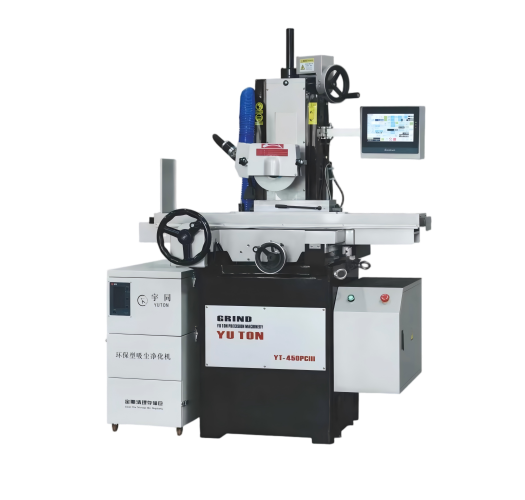
YT-40100CNC CNC Surface Grinder
Ideal for:
- Aerospace components
- Medical devices
- Mold manufacturing
Advantages:
- Fully closed-loop control
- High positioning accuracy
- Exceptional repeatability
Industries Benefiting from Grinding Automation
Grinding automation is increasingly adopted across various industries.
Automotive Manufacturing
Applications include:
- Engine components
- Brake systems
- Transmission parts
Mold and Die Industry
Automation improves consistency during cavity grinding and precision finishing.
Medical Device Manufacturing
Manufacturers benefit from superior surface quality and process traceability.
Aerospace Industry
Precision grinding supports demanding tolerances required for critical components.
Internal Resources
Learn more about grinding technologies:
Manual Surface Grinder Overview:
Automatic Surface Grinder Guide:
CNC Surface Grinding Machine Guide:
Frequently Asked Questions
Is grinding automation suitable for small factories?
Yes. Modern automation systems are specifically designed for SMEs and offer scalable investment options.
How quickly can automation deliver ROI?
Most manufacturers achieve return on investment within 12 to 18 months depending on labor costs and production volume.
Can automated grinding maintain high precision?
Absolutely. Advanced CNC and force-control systems provide excellent repeatability and accuracy.
Do I need robotics experience?
No. Modern collaborative systems are designed for easy operation and require minimal training.
Conclusion
Grinding automation is no longer reserved for large corporations. Today, small and medium-sized manufacturers can improve productivity, reduce labor costs, and achieve consistent quality through affordable automation solutions.
Whether you are starting with a PLC-controlled surface grinder or implementing a fully automated CNC grinding system, the right investment can significantly enhance your competitiveness.
With more than 15 years of manufacturing experience, ISO 9001 certification, CE-compliant products, and global export expertise, YUTON helps manufacturers worldwide implement practical grinding automation solutions tailored to their production requirements.
Request a Quote
Looking for the right grinding automation solution?
Contact YUTON today to discuss your application, receive technical recommendations, and request a customized quotation.